
Key takeaways
- Compare five foam rollers for runners, from smooth high-density rollers to textured deep-tissue models, and pick the length and firmness for recovery.
What's inside
As an Amazon Associate I earn from qualifying purchases. This post may contain affiliate links at no extra cost to you.
- Top Pick: TriggerPoint GRID 1.0 Foam Roller, 13-Inch
- Runner-up: Amazon Basics High-Density Foam Roller, 18-Inch
- Also consider: LuxFit Speckled Foam Roller, 24-Inch
Running asks a lot of the same muscles, run after run. Calves, quadriceps, hamstrings, glutes, and the band along the outside of the thigh all take repeated impact, and tightness in any of them can make the next run feel heavier than it should. A foam roller gives runners a simple way to work on those areas at home, using body weight to apply slow, controlled pressure along a muscle, pause on a tender spot, and then move on.
The right roller depends on how firm you want the pressure to feel, how much space you have, and whether you want a smooth surface or a textured one. A short roller fits in a gym bag and suits targeted work on calves and feet, while a longer roller covers the back and both legs more efficiently.
As an Amazon Associate, we earn from qualifying purchases.
Quick Answer
For most runners, the TriggerPoint GRID 1.0 is the best starting point, because its three-zone surface gives targeted pressure in a compact, durable roller. Runners who want a simple smooth roller should choose the Amazon Basics 18-inch model, while the LuxFit 24-inch roller suits full-body work. The 321 Strong and RumbleRoller Compact suit deeper, more focused pressure.
TriggerPoint GRID 1.0 Foam Roller, 13-Inch

The TriggerPoint GRID 1.0 is the best-known roller in this guide, and it earns that place with a surface divided into three zones: flat panels, tubular ridges, and dense nodules. The flat areas spread pressure broadly, the tubes give a firmer line of pressure, and the nodules focus on smaller, tighter spots.
Under the surface, the GRID 1.0 uses EVA foam over a rigid, hollow core, which keeps the roller from flattening under body weight. At 13 inches long and 5.5 inches in diameter, it is compact enough for a gym bag, although rolling the full back takes more than one pass.
Specs
| Specification | Detail |
|---|---|
| Length | 13 inches |
| Diameter | 5.5 inches |
| Material | EVA foam over a rigid hollow core |
| Surface | Three-zone textured surface with flat panels, tubular ridges, and dense nodules |
| Firmness | Standard firm |
| Item weight | 0.5 kilograms |
| Included extras | Online instructional videos |
| Warranty | 1 year |
Amazon Basics High-Density Foam Roller, 18-Inch

The Amazon Basics roller is the simplest pick in this guide, and for many runners that simplicity is the point. It is a smooth, round, high-density cylinder with no bumps, ridges, or hollow core, so the pressure it gives is even and predictable. That makes it a good first roller for runners who are new to foam rolling, or for anyone who finds textured rollers too intense on sore calves and quadriceps.
The 18-inch length is a useful middle size. It is long enough to roll both calves at once and to cover most of the back without constant repositioning, yet it is still short enough to store in a cupboard or carry to the gym. The roller is made from polypropylene foam, listed as firm, and measures 18 by 6 by 6 inches.
Specs
| Specification | Detail |
|---|---|
| Length | 18 inches |
| Diameter | 6 inches |
| Material | Polypropylene |
| Surface | Smooth |
| Firmness | Firm |
| Item weight | 0.27 kilograms |
| Included extras | Not stated |
| Warranty | Not stated |
LuxFit Speckled Foam Roller, 24-Inch

The LuxFit roller is the best choice in this guide for runners who want one long roller for full-body sessions. At 24 inches long, it covers the whole back in a single pass and lets you roll both legs together, which saves time after a long run.
This is an extra-firm roller made from molded polypropylene foam, with a published density of 2 pounds per cubic foot. The smooth, speckled surface repels liquids and is designed to hold its shape after heavy use, rather than softening and flattening over time. The listing gives the dimensions as 23.9 by 5.9 by 5.9 inches, so the working diameter is close to 6 inches.
Specs
| Specification | Detail |
|---|---|
| Length | 24 inches |
| Diameter | 5.9 inches |
| Material | Polypropylene |
| Surface | Smooth speckled surface |
| Firmness | Extra firm |
| Foam density | 2 pounds per cubic foot |
| Included extras | Online instructional video |
| Warranty | 3-year limited warranty |
321 Strong Foam Roller, Medium Density, 13-Inch
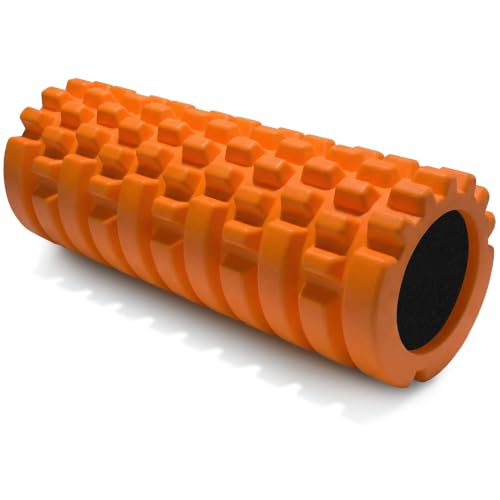
The 321 Strong roller is the most travel-friendly textured pick in this guide. It measures about 12.5 inches long and 5.5 inches in diameter, weighs about 1 pound, and fits easily in a gym bag or a suitcase, so it suits runners who roll at the gym, at a race, or away from home. Despite its small size, it is a proper deep-tissue roller, with a solid core wrapped in closed-cell EVA foam.
Its surface uses three massage zones with projections of different sizes, designed to feel like fingertips, thumbs, and palms. The medium density is firmer than a soft foam roller but gentler than the extra-firm textured models, which makes it a good middle step for runners who find a smooth roller too mild and a very firm roller too intense.
Specs
| Specification | Detail |
|---|---|
| Length | 12.5 inches |
| Diameter | 5.5 inches |
| Material | EVA foam with a solid core |
| Surface | Three-zone textured surface with projections of different sizes |
| Firmness | Medium |
| Item weight | About 1 pound |
| Included extras | eBook |
| Warranty | Not stated |
RumbleRoller Original Textured Foam Roller, Compact

The RumbleRoller Compact is the firmest and most intense roller in this guide, and it is the pick for runners who already know they want deep, focused pressure. Instead of small ridges, its surface is covered in firm, flexible bumps with wide spaces between them. As you roll, the bumps press into the muscle and the spaces give soft tissue room to move, which the maker describes as working like the thumbs of a massage therapist.
This compact version measures 13 inches long and 5 inches in diameter, according to the product description, which makes it portable enough for a gym bag while still long enough for single-leg work. The original density is listed as medium firm, and an extra-firm version is sold separately under a different listing. The listing does not publish a consistent item weight or a warranty length, so treat both as not stated.
Specs
| Specification | Detail |
|---|---|
| Length | 13 inches |
| Diameter | 5 inches |
| Material | Foam |
| Surface | Textured surface with firm, flexible bumps |
| Firmness | Original, medium firm |
| Item weight | Not stated |
| Included extras | Not stated |
| Warranty | Not stated |
How to Choose
Start with firmness, because firmness decides whether rolling feels helpful or simply painful. A smooth, firm roller gives even pressure and suits beginners and gentle recovery days. A medium-density textured roller adds focus without becoming harsh, while an extra-firm roller with large bumps gives the deepest pressure and suits runners who already roll regularly.
Next, choose a length that fits where you will roll. A 12 or 13-inch roller is portable and suits calves, quadriceps, and single-leg work, but it takes more passes to cover the back. An 18-inch roller is a good all-round size for home and gym use. A 24-inch or longer roller covers the back and both legs efficiently and suits full-body sessions at home, but it is awkward to carry. Most full-size rollers are close to 6 inches across, while compact rollers are a little narrower and can reach smaller areas.
Who Should Skip
Foam rollers are not right for everyone, and they are not a treatment for injury. Skip foam rolling, or ask a doctor or physical therapist first, if you have an acute injury, a fracture, a blood clot, nerve pain, or numbness, or if rolling a particular area causes sharp pain rather than mild discomfort.
Beginners should skip the firmest textured rollers, including the RumbleRoller Compact, until they know how their muscles respond to rolling. A smooth roller is a safer first step, and a medium-density textured roller is the next step up. Anyone who wants a powered or vibrating recovery tool should look elsewhere, since every roller in this guide is a manual tool that relies on body weight alone.
FAQ
How long should a foam rolling session last?
A short session of five to ten minutes after a run is enough for most runners. Roll slowly along each muscle group, pause for twenty to thirty seconds on a tender spot, and breathe steadily while you hold the pressure.
How often should runners use a foam roller?
Most runners can roll after most runs, and on rest days as well, as long as the pressure feels like mild discomfort rather than sharp pain. Daily rolling suits the calves, quadriceps, and hamstrings after hard sessions.
Is a textured foam roller better than a smooth one?
Neither is better for every runner. A smooth roller gives even pressure and suits broad work, beginners, and sensitive areas. A textured roller concentrates pressure and suits targeted work on knots and tight spots.
Can foam rolling replace stretching?
Foam rolling and stretching do different jobs, so one does not replace the other. Rolling applies pressure to muscle tissue and can help an area feel looser before stretching, while stretching lengthens a muscle through its range of motion.
Final Verdict
For most runners, the TriggerPoint GRID 1.0 is the best overall pick, because its three-zone surface, hollow core, and compact 13-inch size cover targeted recovery without taking up much space. Runners who want the simplest option should choose the Amazon Basics 18-inch roller, a budget smooth roller that does the basics well. The LuxFit 24-inch roller is the best pick for full-body sessions at home, thanks to its length, extra-firm foam, and 3-year limited warranty. The 321 Strong roller is the best travel pick, with a textured surface in a light 13-inch size, and the RumbleRoller Compact is the best pick for experienced rollers who want the deepest pressure.
Related guides
More from Amazon
Programs that pair well with the guide above. Offers and eligibility are set by Amazon and may change.
Free shipping on eligible items, Prime Video and more. Eligible new members can start with a free trial.
Start a Prime free trialAudiobooks and podcasts to listen to on the go. Eligible new members can start with a free trial.
Try Audible freeAd-free music streaming. Eligible new subscribers can start with a free trial.
Try Music Unlimited freeA free business account with business pricing and bulk-buying tools for work, shop or home office.
Create a business accountAs an Amazon Associate we earn from qualifying purchases.




Write Your Review
No reviews yet. Be the first to share your experience!