
Key takeaways
- Compare five home espresso machines, from budget pump models to a fully automatic pick, checked by pump pressure, grinder, tank size, and milk system.
What's inside
As an Amazon Associate I earn from qualifying purchases. This post may contain affiliate links at no extra cost to you.
Home espresso machines fall into three camps: manual pump machines that use a portafilter and ground coffee, pump machines with a built-in grinder, and fully automatic models that grind, tamp, and brew at the touch of a button. The five machines below cover all three camps, ordered roughly by how much work they ask of the person making the coffee. Every pick is a true espresso machine with a pressurized pump system, and the comparison sticks to published specifications: pump pressure, portafilter or grinder type, water tank size, and how each one handles milk.
As an Amazon Associate, we earn from qualifying purchases.
Quick Answer
The Breville Barista Express is the most complete pick for most homes, pairing a 15-bar pump with a built-in grinder. The Philips 3200 LatteGo suits anyone who wants one-touch drinks. On a budget, the De’Longhi Stilosa and Casabrews CM5418 cover the basics, while the Breville Bambino adds fast heat-up in a slim body.
The Five Machines, From Manual to Fully Automatic
De’Longhi Stilosa (EC260BK) — Budget
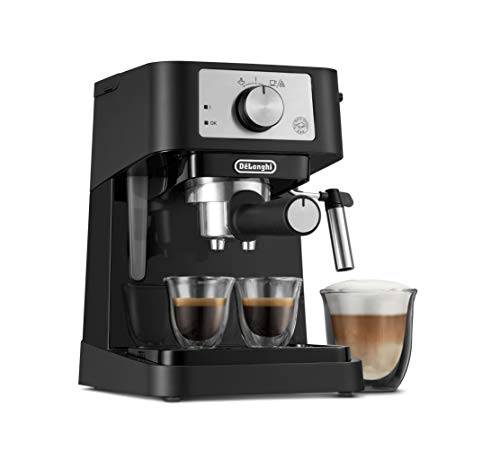
The Stilosa is the classic starter pump machine: a compact body, a traditional portafilter, and a manual frother wand for cappuccinos and lattes. It uses pressurized filter baskets, which are forgiving of grind size and pre-ground coffee, so it pairs happily with a basic grinder or a bag of ground espresso. The control dial keeps operation simple, with settings for brewing, steam, and hot water.
The trade-offs are the ones expected at this tier. The tamper is a lightweight plastic piece, the frother is a panarello style wand that adds air generously rather than producing fine microfoam, and there is no pressure gauge or temperature control to fine-tune a shot. For a first machine that teaches the basic routine of dosing, tamping, and steaming, it covers the essentials.
Specs
- Pump: 15-bar
- Portafilter: 51 mm, single and double pressurized baskets included
- Milk system: manual panarello frother wand
- Water tank: 1.0 L removable
- Power: 1100 W
- Extras: tamper included, two-level cup holder, stainless steel boiler
Casabrews CM5418 — Budget

The Casabrews CM5418 packs a 20-bar pump and a built-in pressure gauge into a slim stainless steel body that suits narrow counters. The gauge is a genuinely useful learning tool at this tier, since it shows whether the puck is resisting the pump or channeling. A cup warmer sits on top, and the drip tray removes for taller cups and easy rinsing.
Like the Stilosa, it uses pressurized baskets and a manual steam wand, so the workflow is fully manual: grind, tamp, brew, then steam. The 34 oz tank is on the small side for households making several milk drinks in a row, and the housing mixes stainless panels with plastic trim. As a compact first machine with feedback from the gauge, it is well specified for its class.
Specs
- Pump: 20-bar
- Portafilter: 51 mm, single and double baskets included
- Milk system: manual steam wand
- Water tank: 34 oz removable
- Power: 1350 W
- Extras: built-in pressure gauge, top cup warmer, compact stainless body
Breville Bambino (BES450BSS) — Mid-Range
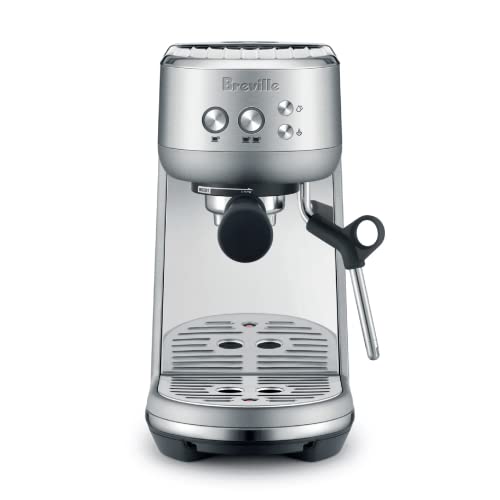
The Bambino is built around speed and a small footprint. Its ThermoJet heating system reaches brewing temperature in about three seconds, and low-pressure pre-infusion gently soaks the puck before full pressure, which helps even extraction. The 54 mm portafilter takes a 19 gram dose, and both single-wall and dual-wall baskets are in the box, so it can grow with a better grinder over time.
Milk handling is the standout here: the automatic steam wand textures milk hands-free and stops at the selected temperature, which removes the steepest learning curve for lattes and flat whites. There is no built-in grinder, so budget for a separate burr grinder, and the drip tray is shallow. For small kitchens that still want proper portafilter espresso, it is the natural step up.
Specs
- Heating system: ThermoJet, ready in about 3 seconds
- Pump: 15-bar with low-pressure pre-infusion
- Portafilter: 54 mm, 19 g dose, single-wall and dual-wall baskets included
- Milk system: automatic steam wand with temperature sensor
- Water tank: 47 oz removable
- Power: 1560 W
Philips 3200 LatteGo (EP3241/54) — Premium

The Philips 3200 is the fully automatic option: beans go in the hopper, and the machine grinds, tamps, brews, and dispenses on its own. The touch display offers five drinks, and the My Coffee Choice menu adjusts strength, volume, and milk amount. The ceramic burr grinder has 12 settings and is rated for long service without wearing down.
The LatteGo milk carafe is the convenience highlight. It has only two parts, no tubes, and goes in the dishwasher, which solves the stale-milk-in-the-frother problem that plagues many automatic machines. The AquaClean filter stretches descaling intervals considerably, and the brew group removes for rinsing under a tap. The compromise is control: there is no portafilter and no way to manage dose or distribution manually, so it suits drinkers who value repeatability over ritual.
Specs
- Type: fully automatic bean-to-cup
- Grinder: ceramic burr, 12 grind settings
- Drinks: espresso, coffee, americano, cappuccino, latte macchiato, hot water
- Milk system: LatteGo carafe, two parts, dishwasher safe
- Pump: 15-bar
- Water tank: 1.8 L, front access
- Filter: AquaClean, up to 5000 cups before descaling
Breville Barista Express (BES870XL) — Premium

The Barista Express combines a 15-bar pump machine with a built-in conical burr grinder, so it needs no separate grinder to get started. Dose-control grinding dispenses directly into the 54 mm portafilter, and the included trimming tool levels the puck. A pressure gauge on the front panel shows the extraction zone, and the Thermocoil heating system with digital temperature control keeps brew water stable.
It is the most manual machine in this list despite the integration: the steam wand is fully manual, grind size and dose are the user’s responsibility, and the learning curve is real. In return it offers the most headroom, since it accepts both pressurized and non-pressurized baskets and works with any beans. The 67 oz tank and half-pound bean hopper also make it the best suited here to serving several drinks in a row.
Specs
- Grinder: built-in conical burr with dose control, 8 oz bean hopper
- Pump: 15-bar, Thermocoil with digital temperature control
- Portafilter: 54 mm stainless steel, single-wall and dual-wall baskets included
- Milk system: manual steam wand, separate hot water outlet
- Water tank: 67 oz removable with filter
- Power: 1600 W
- Extras: extraction pressure gauge, dose trimming tool, integrated tamper
How to Choose
Start with how much of the process you want to own. Manual pump machines such as the Stilosa and the CM5418 cost the least and teach the full routine, but every drink takes a few minutes of active work and a separate grinder is a near-essential partner. A machine with a built-in grinder, like the Barista Express, removes one appliance from the counter and one variable from the morning. A fully automatic model such as the Philips 3200 trades control for consistency and speed.
Next, look at the milk system, because it shapes daily use more than pump ratings do. A manual wand gives the best texture once learned, an automatic wand like the Bambino’s removes the guesswork, and a carafe system like LatteGo prioritizes easy cleaning. Pump pressure figures above 15 bar are mostly marketing; what matters more is stable temperature, a portafilter size with good accessory support, and pressurized baskets if the machine will run on pre-ground coffee.
Finally, check tank size and footprint against the counter. Slim machines with tanks under 40 oz need frequent refills in multi-person homes, while a 1.8 L or 2 L tank comfortably covers a day of drinks. Measure the space under wall cabinets too, since bean hoppers and top-loading tanks need clearance above the machine.
Who Should Skip a Home Espresso Machine
Households that mostly drink large mugs of filter coffee will get more from a good drip brewer, which is already covered in the drip coffee maker guide on this site. Espresso machines also demand a small daily routine of rinsing, wiping the wand, and emptying the drip tray, plus periodic descaling; anyone who wants zero upkeep is better served by a pod machine. And if counter space is already tight, a pump machine plus a separate grinder can take more room than the coffee habit justifies.
Frequently Asked Questions
Do these machines need a special grinder?
The manual and mid-range picks without a built-in grinder need espresso-fine grounds. Pressurized baskets tolerate a basic burr grinder or pre-ground coffee, while non-pressurized baskets reward a dedicated espresso grinder with fine, even particles and small adjustment steps.
What does the bar rating on a pump actually mean?
The bar figure is the pump’s maximum pressure, not the pressure at the coffee puck. Espresso extracts at around 9 bar, so a 15-bar or 20-bar pump simply has headroom. Shot quality depends far more on temperature stability, grind consistency, and even distribution.
How often does an espresso machine need descaling?
It depends on water hardness and use. Machines with a water filter, such as the Philips 3200 with AquaClean, can run far longer between descaling cycles. As a rule, follow the machine’s indicator or descale every two to three months with unfiltered tap water.
Can a home machine steam milk like a cafe?
Yes, within limits. Manual wands on machines like the Barista Express can produce fine microfoam with practice, and the Bambino’s automatic wand handles temperature for you. Carafe systems such as LatteGo make good foam with no technique, though with less control over texture.
Final Verdict
For most homes, the Breville Barista Express is the safest long-term buy because it pairs a capable pump machine with a built-in grinder and leaves room to improve technique. The Philips 3200 LatteGo is the pick for one-touch convenience and easy milk cleanup. The Breville Bambino fits small counters and fast mornings, while the De’Longhi Stilosa and Casabrews CM5418 keep the entry cost low for anyone learning the basics of portafilter espresso.
Product and ASIN Reference
| Product | ASIN |
|---|---|
| De’Longhi Stilosa Manual Espresso Machine (EC260BK) | B08C96BG9H |
| Casabrews CM5418 Espresso Machine, Silver | B09X3WGJ3R |
| Breville Bambino Espresso Machine (BES450BSS) | B0B1JPPG2L |
| Philips 3200 Series LatteGo Espresso Machine (EP3241/54) | B07VFY4MXM |
| Breville Barista Express Espresso Machine (BES870XL) | B00CH9QWOU |
Related guides
More from Amazon
Programs that pair well with the guide above. Offers and eligibility are set by Amazon and may change.
Free shipping on eligible items, Prime Video and more. Eligible new members can start with a free trial.
Start a Prime free trialAudiobooks and podcasts to listen to on the go. Eligible new members can start with a free trial.
Try Audible freeAd-free music streaming. Eligible new subscribers can start with a free trial.
Try Music Unlimited freeA free business account with business pricing and bulk-buying tools for work, shop or home office.
Create a business accountAs an Amazon Associate we earn from qualifying purchases.
Write Your Review
No reviews yet. Be the first to share your experience!