
Key takeaways
- Compare the best water filter pitchers from Brita, PUR, ZeroWater, LifeStraw and Waterdrop by capacity, certified reductions, filter life and ease of use.
What's inside
As an Amazon Associate I earn from qualifying purchases. This post may contain affiliate links at no extra cost to you.
- Top Pick: Final Verdict
- Runner-up: Final Verdict
- Also consider: Final Verdict
A water filter pitcher is the simplest way to improve tap water at home. There is no plumbing work, no installation and no commitment beyond changing a cartridge on schedule. Fill it from the tap, let gravity do the work, and keep it in the fridge for drinking, cooking, coffee and tea.
The five pitchers below cover the main approaches on the market: a budget-friendly carbon pitcher for taste, a certified lead-reducing pitcher, a long-life cartridge pitcher, a five-stage pitcher that strips dissolved solids, and a glass pitcher with a membrane filter that also targets bacteria and microplastics. Each one is a pitcher with built-in filtration, so the comparison stays focused on capacity, certified reductions, filter life and everyday handling.
As an Amazon Associate, we earn from qualifying purchases.
Quick Answer
For most households, the PUR Plus 11-Cup is the strongest all-round choice because its filter is certified to reduce lead and the pitcher adds a filter change light. The Brita Everyday 10-Cup suits taste-focused filtering on a budget, the Waterdrop Lucid stretches each cartridge to about three months, the ZeroWater 10-Cup removes nearly all dissolved solids, and the LifeStraw Home 7-Cup Glass adds membrane protection against bacteria and microplastics.
Brita Everyday 10-Cup Pitcher
The Brita Everyday is the classic starter pitcher and the budget pick in this group. It uses the Brita Standard filter, a carbon cartridge rated for 40 gallons, which works out to roughly two months of typical household use before a swap. The pitcher body is made without BPA and holds 10 cups, enough to fill three large reusable bottles in one go.
Filtration here is aimed at taste and odor. The Standard filter reduces chlorine taste and odor along with copper, mercury and cadmium, which covers the most common reasons tap water tastes unpleasant. It is not the filter to choose for lead concerns; households worried about lead should look at the PUR Plus or the LifeStraw below instead.
Handling is simple. The lid has a small sticker indicator that helps track when the filter is due, and the oval shape fits most refrigerator doors and shelves. Replacement Standard filters are sold almost everywhere, which keeps ongoing ownership easy.
Specs:
– Capacity: 10 cups
– Filter type: Brita Standard carbon filter
– Filter life: 40 gallons, about 2 months
– Model: 35509
– Reduces: chlorine taste and odor, copper, mercury, cadmium
– Material: BPA-free plastic
PUR Plus 11-Cup Pitcher
The PUR Plus 11-Cup is the mid-range pick for households that want certified lead reduction in a pitcher format. Its PUR Plus filter carries WQA certification for lead reduction, and the system is also certified against NSF/ANSI standards covering taste, odor and a range of contaminants including mercury and certain pharmaceuticals.
At 11 cups, it is the largest pitcher in this roundup, which suits families that refill often. The LockFit cap design helps keep the lid seated while pouring, and a filter change light on the lid removes the guesswork about when the cartridge is spent. Each filter is rated for 40 gallons, about two months of use.
The pitcher itself is dishwasher safe, which makes deep cleaning easier than with hand-wash-only designs. The slim profile is shaped for refrigerator storage, and the pour-through lid means the top stays on while filling at the tap.
Specs:
– Capacity: 11 cups
– Filter type: PUR Plus filter with lead reduction
– Filter life: 40 gallons, about 2 months
– Model: PPT111W
– Certification: WQA certified to reduce lead
– Features: filter change light, LockFit cap, dishwasher safe pitcher
Waterdrop Lucid 10-Cup Pitcher
The Waterdrop Lucid is built around filter life. Its cartridge is rated for 200 gallons, roughly three months, which is several times longer than the 40-gallon cartridges used by Brita and PUR. For households that dislike frequent filter changes, that longer interval is the main attraction.
The Lucid filter is certified to NSF/ANSI 42 and 372 and is rated to reduce PFOA and PFOS, chlorine and other contaminants that affect taste. Waterdrop is clear that this system does not lower the TDS reading of water, so it improves taste and reduces specific contaminants while leaving healthy minerals in place.
The pitcher holds 10 cups and measures about 10 by 5.28 by 10.04 inches, a footprint that sits comfortably on a fridge shelf. A small indicator on the lid tracks filter life, and the fill opening in the lid means it can be refilled without removing the top.
Specs:
– Capacity: 10 cups
– Filter type: Waterdrop pitcher cartridge
– Filter life: 200 gallons, about 3 months
– Model: WD-PT-61B
– Certification: NSF/ANSI 42 and 372
– Reduces: PFOA/PFOS, chlorine, taste and odor contaminants
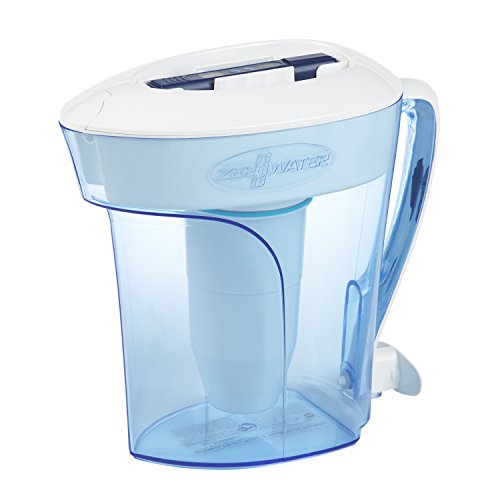
ZeroWater 10-Cup Ready-Pour Pitcher
ZeroWater takes a different approach from carbon-only pitchers. Its five-stage filter uses ion exchange technology to remove nearly all total dissolved solids, and the filtered water typically reads 000 on a TDS meter. A meter is included in the box, so owners can check the reading and know when the filter is exhausted.
The five-stage filter is IAPMO certified to reduce lead, chromium and PFOA/PFOS. That breadth makes this pitcher a strong mid-range to premium option for households whose tap water has a heavy mineral load or a noticeable metallic taste.
The trade-off is filter life. Because the filter removes so much, it fills up faster than a basic carbon cartridge, and life depends heavily on how high the starting TDS is. In areas with very hard water, expect to change filters more often than with any other pitcher here. The Ready-Pour design includes a spigot-style spout that lets you pour while water is still filtering.
Specs:
– Capacity: 10 cups
– Filter type: 5-stage ion exchange filter
– Filter life: varies with starting TDS, shorter than carbon pitchers
– Model: ZP-010
– Certification: IAPMO certified to reduce lead, chromium, PFOA/PFOS
– Includes: TDS meter
LifeStraw Home 7-Cup Glass Pitcher
The LifeStraw Home is the premium pick and the only glass pitcher in this group. It pairs two filter stages: a membrane microfilter that reduces bacteria, parasites and microplastics, and an activated carbon plus ion exchange filter that reduces lead, mercury, PFAS, chlorine and other chemicals.
That membrane stage is what separates it from the other four pitchers. Carbon pitchers improve taste and reduce chemicals, but they do not claim the bacteria and microplastic reduction that the LifeStraw membrane provides, which makes this the natural choice for households that want the broadest protection a pitcher can offer.
The 7-cup glass body sits on a protective silicone base and looks at home on a counter or table. The membrane microfilter lasts up to 264 gallons, roughly a year, while the carbon filter is replaced about every two months or 40 gallons. Capacity is smaller than the plastic pitchers here, so larger families will refill it more often.
Specs:
– Capacity: 7 cups
– Filter type: membrane microfilter plus activated carbon and ion exchange filter
– Filter life: membrane up to 264 gallons, carbon filter 40 gallons
– Model: LSH7GLSWH21
– Reduces: bacteria, parasites, microplastics, lead, mercury, PFAS, chlorine
– Material: glass with silicone base
How to Choose
Start with your water concern. If the problem is taste and odor from chlorine, a basic carbon pitcher such as the Brita Everyday handles it well. If lead is the concern, choose a pitcher whose filter is certified for lead reduction, such as the PUR Plus or the LifeStraw Home, and check the certification details for the exact model.
Next, think about dissolved solids. Only the ZeroWater removes nearly all TDS, which changes the taste of water dramatically and suits people who want the purest-tasting water for drinking and brewing. If you prefer keeping minerals in the water, pick one of the carbon-based pitchers instead.
Filter life shapes the ongoing routine. The Waterdrop Lucid stretches to about three months per cartridge, the Brita and PUR filters run about two months, the LifeStraw carbon filter runs about two months with a yearly membrane change, and the ZeroWater filter life depends on your starting TDS. Households that know they will forget changes should favor longer intervals and a lid indicator.
Finally, match capacity and material to your kitchen. Eleven cups suits families, 10 cups suits most couples and small households, and 7 cups suits one or two people who refill often. Glass looks better and avoids plastic contact, while plastic pitchers are lighter and more forgiving if dropped.
Who Should Skip a Water Filter Pitcher
Skip pitchers if your household drinks a large volume of water every day. Even an 11-cup pitcher needs constant refilling for a big family, and a countertop dispenser or an under-sink system will be less tedious.
Skip pitchers if your water test shows contamination that pitchers are not certified to handle, such as high nitrate levels, arsenic or microbial contamination in well water. Those problems call for a system designed and certified for that specific contaminant, and possibly professional advice.
Skip pitchers if nobody in the household will track filter changes. An exhausted cartridge stops filtering effectively, and a pitcher with an old filter gives a false sense of security. If maintenance will lapse, a plumbed system with a longer service interval is a better fit.
Frequently Asked Questions
Do water filter pitchers remove lead?
Some do and some do not. Lead reduction depends on the specific filter, not the pitcher shape. The PUR Plus filter is certified to reduce lead, and the LifeStraw Home and ZeroWater filters are also rated for lead reduction. The Brita Standard filter focuses on taste, odor and metals such as copper and mercury instead, so check the certification for the exact filter before relying on it for lead.
How often do pitcher filters need changing?
Most carbon pitcher filters are rated for about 40 gallons or two months. The Waterdrop Lucid cartridge lasts about 200 gallons or three months, while the LifeStraw membrane lasts up to 264 gallons with its carbon filter changed about every two months. ZeroWater filters vary the most, because life depends on how much dissolved solid content your tap water starts with.
Does a pitcher filter soften hard water?
Not in the way a water softener does. Carbon pitchers do not remove the calcium and magnesium that cause hardness and scale. The ZeroWater five-stage filter removes nearly all dissolved solids, which includes hardness minerals, but it does so at the cost of shorter filter life in hard-water areas. For whole-home scale problems, a dedicated softener is the right tool.
Can pitcher-filtered water be used for coffee and cooking?
Yes. Pitcher-filtered water is commonly used for coffee makers, kettles, steam irons and cooking, because reducing chlorine taste improves the flavor of drinks and food. Many households keep the pitcher mainly for the coffee maker, since chlorine and mineral notes show up clearly in brewed coffee and tea.
Final Verdict
The PUR Plus 11-Cup is the safest default recommendation: certified lead reduction, the largest capacity here, a filter change light and easy cleaning. Choose the Brita Everyday if taste improvement on a budget is the whole job, the Waterdrop Lucid if you want the longest time between filter changes, the ZeroWater if dissolved solids and taste purity matter most, and the LifeStraw Home Glass if you want membrane-level protection against bacteria and microplastics in a glass pitcher. Any of the five is a clear step up from unfiltered tap water, so the right pick is the one whose filter matches the concern in your own water report.



Related guides
More from Amazon
Programs that pair well with the guide above. Offers and eligibility are set by Amazon and may change.
Free shipping on eligible items, Prime Video and more. Eligible new members can start with a free trial.
Start a Prime free trialAudiobooks and podcasts to listen to on the go. Eligible new members can start with a free trial.
Try Audible freeAd-free music streaming. Eligible new subscribers can start with a free trial.
Try Music Unlimited freeA free business account with business pricing and bulk-buying tools for work, shop or home office.
Create a business accountAs an Amazon Associate we earn from qualifying purchases.




Write Your Review
No reviews yet. Be the first to share your experience!