
Key takeaways
- Benchtop wood lathes with reverse rotation compared on swing, distance between centers, speed ranges, motor power and spindle thread, from the listings.
What's inside
As an Amazon Associate I earn from qualifying purchases. This post may contain affiliate links at no extra cost to you.
Reverse rotation is the feature that separates a short list of benchtop wood lathes from the rest of the shelf. Sanding a bowl with the grain in one direction leaves fibers lying flat and rough; flipping the spindle lets the abrasive cut those fibers cleanly, and reverse also helps when a blank is easier to reach from the outboard side. The catch is that capacity still rules the purchase: swing over the bed sets the widest blank that fits, and distance between centers sets the longest spindle, whatever direction the motor turns.


This guide is for bowl turners who sand in both directions, spindle turners who need honest capacity figures, and outboard turners working in small shops. Every lathe below is a benchtop, mini, or midi wood lathe whose Amazon listing states a forward and reverse spindle, and each was chosen from the names and specifications on its product page, including swing, speed ranges, motor rating, spindle thread, and taper, rather than from brand reputation alone.
Quick Picks
As an Amazon Associate we earn from qualifying purchases
| Product | Best for | Key spec from title |
|---|---|---|
| JET JWL-1221VS Variable-Speed Wood Lathe | The longest spindle capacity in this group | 12 x 21 in, 1 HP |
| Delta Industrial 46-460 Midi Lathe | Sanding-heavy finishing on bowls and spindles | 12-1/2 in swing, up to 4,000 RPM |
| RIKON Power Tools VSR MIDI Lathe (RIK-70-150VSR) | Compact benches that still need reverse | 12-1/2 x 16-1/2 in, 95 lb |
| Laguna Revo 1216 Midi Lathe EVS | Outboard bowl turning | 16 in max outboard swing |
How to Choose
Swing and Distance Between Centers
Swing over the bed is the largest diameter that can spin over the ways, so a lathe listed at 12-1/2 inches of swing cannot rough out a blank much wider than that once bark and wobble are accounted for. Distance between centers is the length limit for spindle work such as chair legs and tool handles. Three of the lathes here sit near 16-1/2 inches between centers, while the JET stretches to 21 inches. Check both figures against the work you actually plan, and remember that swing over the tool rest base or banjo is always smaller than swing over the bed.
Speed Range and How the Speed Changes
Every lathe in this group pairs electronic variable speed with belt positions, so the dial fine-tunes within a range and the belt sets which range you are in. Look at the bottom of the low range first: the Laguna starts at 50 RPM and the JET at 60 RPM, which matters when an unbalanced bowl blank goes on the chuck, while the RIKON and Delta start higher at 250 RPM. Top speed matters for small spindle work and pens. A digital readout removes guesswork when returning to a speed that worked.
Motor Power and Spindle Fittings
All four lathes in this group run a 1 HP motor, so the headline rating alone will not separate them; how the power is delivered matters more, with DC motors and a pulse width modulation controller on some models and a conventional drive on others. Fittings decide what your existing gear can do. All four use a 1 inch by 8 TPI spindle thread and a number 2 Morse taper in the headstock and tailstock, which keeps chucks and centers interchangeable across the group. For reverse work, confirm the chuck has a set screw or locking feature so it cannot unthread.
Bed Construction and Weight for Vibration
Cast iron beds dominate this class because mass is the cheapest vibration control a benchtop lathe can have. The lathes here run from 95 pounds for the RIKON to about 130 pounds for the JET, and that spread is noticeable when a rough blank starts out of round. A heavier bed also stays put on the bench without bolting down, though bolting or a stand still helps for outboard work. Machined bed ends matter too: extensions fitted at the headstock end are how outboard turning and extra length get added later.
The 4 Best Options
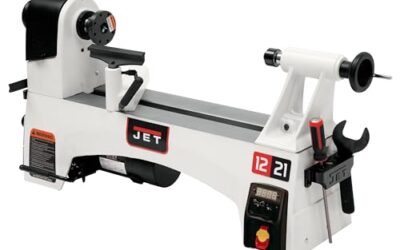
JET JWL-1221VS Variable-Speed Wood Lathe
The JET is the pick for turners whose work mixes bowls with longer spindle pieces, because its 21 inches between centers is the longest capacity in this group while the swing stays at 12 inches. A forward and reverse sliding switch sits beside the speed knob on the redesigned control panel, so changing direction for a sanding pass does not mean reaching across the work. Three speed ranges run from 60 RPM for roughing an uneven blank up to 3,600 RPM, changed with a ratchet-style belt tension system that needs no tools.
Specs
- Model: JWL-1221VS (719200)
- Swing over bed: 12 in
- Distance between centers: 21 in
- Motor: 1 HP, 115V, single phase
- Speed range: 60 to 3,600 RPM across three ranges
- Spindle direction: forward and reverse
- Indexing: 24 positions
- Spindle thread: 1 in x 8 TPI; headstock and tailstock taper: MT2
- Dimensions: 32.8 x 14.6 x 21.2 in; item weight: 129.8 lb
- Warranty: 5 years
Best for: Turners who split time between bowls and longer spindle work like furniture legs.
Watch out for: The listing covers the lathe only, so confirm whether a stand is bundled before assuming the bench can stay clear.
ASIN: B00BGBVJCU
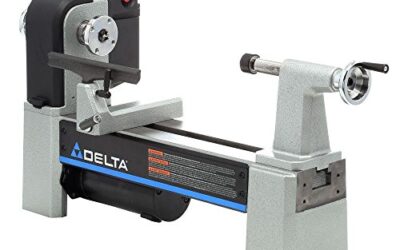
Delta Industrial 46-460 Variable-Speed Midi Lathe
Delta built the 46-460 around finishing work: its listing leads with the forward and reversing function, explaining that sanding against the grain cuts fibers smooth instead of laying them down. The three pulley ranges top out at 4,000 RPM, the highest ceiling here, which suits pens and small spindles. Swing is 12-1/2 inches and the standard bed takes 16-1/2 inches between centers. A patented belt tensioning system speeds up range changes, and the faceplate carries set screws so it stays put when the spindle runs in reverse.
Specs
- Model: 46-460
- Swing over bed: 12-1/2 in
- Distance between centers: 16-1/2 in, up to 42 in with the optional bed extension
- Motor: 1 HP max, 120V, 60 Hz, single phase
- Speed ranges: 250-700, 600-1,800 and 1,350-4,000 RPM, electronic variable speed
- Spindle direction: forward and reverse
- Headstock and tailstock taper: number 2 Morse taper
- Spindle thread: 1 in x 8 TPI
- Included: 3 in faceplate, 6 in and 10 in tool rests, ball-bearing live center, knockout bar
Best for: Finish-focused turners who sand every piece in both directions.
Watch out for: The 42 inch capacity needs the optional 46-463 bed extension, so check whether the offer in front of you includes it or sells it separately.
ASIN: B00309ZZRQ
RIKON Power Tools VSR MIDI Lathe (RIK-70-150VSR)
The RIKON is the lightest lathe in this group at 95 pounds, which suits benches that get cleared for other work, yet the bed is still cast iron. Its control box hangs on a cord and sticks to the front of the bed with magnets, so the speed dial, digital readout, and direction control can sit wherever your stance puts them, including at the tailstock end during outboard sanding. Three ranges cover 250 to 3,200 RPM, and the listing lists the drive direction plainly as forward and reverse.
Specs
- Model: RIK-70-150VSR
- Swing over bed: 12-1/2 in
- Distance between centers: 16-1/2 in
- Motor: 1 HP DC, 120V, 60 Hz, 6 amps
- Speed ranges: 250-850, 430-1,450 and 950-3,200 RPM, electronic variable speed with digital RPM readout
- Spindle direction: forward and reverse
- Spindle thread: 1 in x 8 TPI RH; headstock and tailstock taper: MT2
- Tailstock ram travel: 3-1/2 in
- Indexing: 24 positions
- Item weight: 95 lb; dimensions: 39 x 13 x 15 in
- Included: spur center, live center, 3 in faceplate, 6 in tool rest, knock-out bars, wrenches, tool holder
Best for: Turners who move the lathe on and off a shared bench and want controls that move with them.
Watch out for: Range changes still need a belt move under the pivoting cover, so check the belt position matches the range you dial in before starting a blank.
ASIN: B0911NMGH1
Laguna Revo 12|16 Midi Lathe EVS
The Laguna is the bowl specialist of the four. Its low range starts at 50 RPM, the slowest starting speed here, and the pulse width modulation controller is there to hold torque at those speeds instead of letting the motor lug. The spindle is threaded at both ends, and with the optional extension fitted at the headstock the lathe turns outboard up to a 16 inch swing, where reverse rotation earns its keep on the far side of a bowl. Between centers is the shortest here at 15-1/2 inches.
Specs
- Model: MLAREVO1216EVS
- Swing over bed: 12-1/2 in; swing over banjo: 9-1/2 in; max outboard swing: 16 in
- Distance between centers: 15-1/2 in
- Motor: 1 HP DC permanent magnet with PWM controller, 110V, single phase, 60 Hz
- Speed ranges: 50-525, 325-1,750 and 650-3,500 RPM
- Spindle direction: forward and reverse
- Spindle thread: 1 in x 8 TPI at both ends; spindle and tailstock taper: MT2
- Indexing: 24 positions with lock
- Tailstock quill travel: 2-1/2 in
- Faceplate: 3 in
- Net weight: 118 lb
Best for: Bowl turners who rough out unbalanced blanks slowly and want outboard capacity later.
Watch out for: The stand, bed extension, and light are separate accessories, so confirm exactly what the listing bundles before comparing offers.
ASIN: B076B8S4HG
Which One Fits Your Situation
You Sand Every Bowl in Both Directions
Pick the Delta 46-460. Its listing is built around the forward and reversing function for finishing, the included faceplate locks with set screws for reverse work, and the speed range reaches 4,000 RPM for the small pieces that follow the bowls. The RIKON is the fallback if the Delta offer disappears, since its direction control rides on the movable control box.
You Turn Table Legs and Longer Spindles
Pick the JET JWL-1221VS. At 21 inches between centers it swallows chair and table parts that the three 16-1/2 inch lathes cannot take without an extension, and the 60 RPM bottom end still lets you rough a spindle blank gently. Reverse remains on hand for the final sanding passes once the shape is cut.
You Want to Turn Bowls Outboard
Pick the Laguna Revo 12|16. The double-threaded spindle and the extension position at the headstock end open up a 16 inch outboard swing, and reverse rotation lets you sand the outside of a bowl from a comfortable stance. Its 50 RPM starting speed also suits the heavy, unbalanced blanks that outboard work usually begins with.
Your Bench Is Shared or Short on Space
Pick the RIKON 70-150VSR. At 95 pounds it is the easiest of the four to lift off the bench and store, and the magnetic control box means the controls never dictate where the lathe has to sit. Capacity matches the Delta at 12-1/2 by 16-1/2 inches, so small-shop turners give up length only against the JET.
Common Mistakes
- Assuming any variable-speed lathe can reverse: many popular mini lathes are forward only, so check that the listing states a reverse or forward and reverse drive before ordering.
- Sanding in reverse with a chuck that has no set screw or lock, which lets the chuck slowly unthread from the spindle nose.
- Reusing a chuck from an older lathe without checking the spindle thread, since an insert mismatch means the chuck never seats properly.
- Judging capacity by swing over the bed alone and forgetting that swing over the banjo or tool rest base is the tighter limit on real blanks.
- Starting an out-of-round blank in the high belt range instead of the lowest range, which shakes the bench and can walk a light lathe.
Frequently Asked Questions
Why does reverse rotation matter when sanding?
Sanding with the grain lays wood fibers down in one direction, and they spring back rough once finish is applied. Running the spindle in reverse presents those fibers to the abrasive from the other side, so they are cut cleanly instead of folded over. Alternating direction between grits is the way turners use the feature, and it is why the listings call out forward and reverse as a finishing function.
Can you turn in reverse, or is it only for sanding?
Reverse is primarily a finishing and access tool. Most turning cuts are made in forward rotation, where tool rests and cutting angles are set up to work. Reverse earns its place during sanding, when working on the outboard side of a headstock, and for a few specialty operations. Whatever the direction, the workholding must be locked, because a threaded chuck that is secure in forward can loosen in reverse.
Do all benchtop wood lathes have a reverse function?
No. Several well-known mini and midi lathes are forward only, and their listings state a single spindle direction or say nothing about reversing at all. Reverse tends to appear on mid-range benchtop models like the four in this guide. If a product page does not state forward and reverse, a reversing switch, or a reversible motor, treat the lathe as forward only and choose a different model.
What should I check before sanding in reverse?
Confirm the chuck or faceplate is locked to the spindle, ideally with the set screws the manufacturer provides for reverse work, and run the lathe empty for a few seconds to be sure nothing walks loose. Keep the speed moderate, hold the abrasive so a catch cannot pull it into the work, and remember that dust now throws toward the opposite side of the lathe.
Related guides
More from Amazon
Programs that pair well with the guide above. Offers and eligibility are set by Amazon and may change.
Free shipping on eligible items, Prime Video and more. Eligible new members can start with a free trial.
Start a Prime free trialAudiobooks and podcasts to listen to on the go. Eligible new members can start with a free trial.
Try Audible freeAd-free music streaming. Eligible new subscribers can start with a free trial.
Try Music Unlimited freeA free business account with business pricing and bulk-buying tools for work, shop or home office.
Create a business accountAs an Amazon Associate we earn from qualifying purchases.
Write Your Review
No reviews yet. Be the first to share your experience!