
Key takeaways
- Compare the best benchtop wood lathes for small professional workshops, with cast-iron midi and mini models, variable speed and honest capacity figures.
What's inside
As an Amazon Associate I earn from qualifying purchases. This post may contain affiliate links at no extra cost to you.
A small professional shop does not choose a benchtop lathe the way a hobbyist does. The real decision is whether a bench-sized machine can hold production tolerances all week: roughing bowl blanks without stalling, turning repeat spindle parts to a consistent diameter, and surviving daily use without the bed flexing or the tailstock drifting out of alignment. A floor lathe answers those demands with sheer mass and motor size, but most small shops cannot surrender the floor space, so the benchtop machine has to deliver the same discipline in a much smaller footprint.

This guide is for professional turners, small furniture shops, and production craft businesses working in limited floor space. Every machine below is a genuine benchtop wood lathe, and each pick was chosen from the specifications, capacities, and included components stated on its Amazon product page. Whether you need one lathe as the main turning machine or a second, specialized station that keeps small work off the primary lathe, the options below are matched to those roles.
Quick Picks
As an Amazon Associate we earn from qualifying purchases
| Product | Best for | Key spec from title |
|---|---|---|
| Delta Industrial 46-460 | Daily production turning in a compact shop | 12-1/2-Inch Variable-Speed Midi Lathe |
| JET JWL-1015VS | Precision bowl and spindle work on a tight bench | 10″ x 15″ Wood Lathe, Variable Speed |
| WEN LA3424 | Full 12 x 18 capacity on a working budget | 12-Inch by 18-Inch 5-Speed Benchtop Wood Lathe |
| RIKON 70-105 | Dedicated pen and small-parts turning | 10 x 18 Mini Lathe |
How to Choose
Match swing and between-centers distance to your actual product line
Capacity figures decide what work you can accept, so read them against your order book rather than your ambitions. Swing over bed sets the largest bowl or platter diameter; a 12-1/2-inch swing realistically finishes bowls around 11 inches once the blank is trued. Distance between centers sets spindle length: 15-1/2 inches covers pens, tool handles, and small balusters, while 18 inches reaches rolling pins and longer furniture parts. Shops that regularly turn chair legs or bedposts should confirm a bed extension exists for the model before buying, because outgrowing the bed is the most common reason a benchtop lathe gets replaced within a year.
Decide between electronic variable speed and belt-stepped speeds
How a lathe changes speed shapes your working rhythm. Electronic variable-speed models let you dial from roughing to finishing speeds without stopping the cut, which matters when you true an out-of-round blank slowly and then accelerate for final passes on the same piece. Belt-stepped machines offer a handful of fixed speeds changed by moving a belt on pulleys; they are mechanically simple and durable, but every speed change interrupts the job. For mixed production work, electronic control saves real minutes per piece. For a single-purpose station, such as a pen-turning bench that lives at one speed, a stepped drive is perfectly adequate.
Weight and cast iron are your vibration control
A benchtop lathe has no floor stand to absorb vibration, so its own mass does that job. Cast-iron beds, headstocks, and tailstocks in the 70-to-110-pound range stay planted when an unbalanced blank spins up, while lighter steel or aluminum machines walk across the bench and leave chatter marks on the work. Check what the castings are actually made of on the listing, not just the shipping weight, and plan to bolt the lathe down regardless. In a professional setting, also confirm the tailstock locks firmly and the quill travel suits your drilling work, since a slipping tailstock ruins deep-bored parts.
Standardize on spindle thread and taper before you buy tooling
Every lathe here uses a 1-inch by 8 TPI spindle thread and MT2 headstock and tailstock tapers, and that standardization is worth money. Chucks, faceplates, drive centers, and drill chucks bought for one machine fit the others, so a two-lathe shop can share tooling instead of duplicating it. Before ordering, verify the listing states the thread and taper explicitly, and check which accessories are included in the box: a lathe shipped with a live center, spur center, faceplate, and tool rest can go straight into service, while a bare machine needs a tooling order before it earns anything.
The 4 Best Options
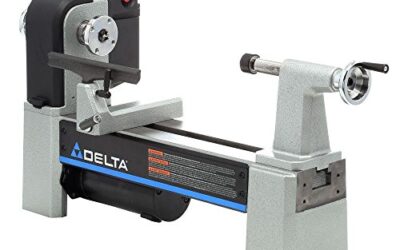
Delta Industrial 46-460
The 46-460 is the closest thing here to a production machine that still sits on a bench. Its 1-horsepower motor and 12-1/2-inch swing handle bowl blanks and spindle stock that would stall smaller lathes, and the three electronic speed ranges cover everything from slow roughing to fine finishing without a belt change for most work. Forward and reverse rotation is a genuine professional feature: reversing while sanding produces noticeably smoother surfaces on figured grain. Shops turning daily for paying customers will feel the difference in the patented belt-tensioning system too, because speed range changes stay quick instead of becoming a chore avoided at the cost of cut quality.
Specs
- Motor: 1 HP maximum, variable speed
- Speed ranges: 250-700, 600-1800, and 1350-4000 RPM
- Swing over bed: 12-1/2 inches
- Distance between centers: 16-1/2 inches
- Spindle: 1 inch x 8 TPI, forward and reverse
- Headstock and tailstock taper: MT2
- Includes ball-bearing live center and heavy-duty steel knockout bar
- Onboard storage for adjustment tools
Best for: Small shops turning bowls and spindles daily that need full-size power in a bench footprint.
Watch out for: The stand and bed extension are separate purchases, so budget for them if you plan longer work.
ASIN: B00309ZZRQ
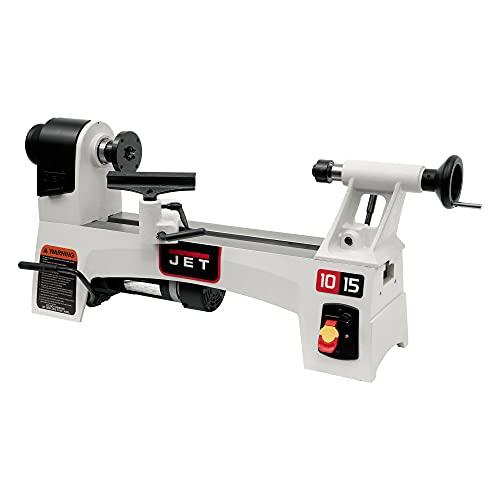
JET JWL-1015VS
JET built the JWL-1015VS for turners who measure a lathe by the quality of its castings. The bed, headstock, and tailstock are all cast iron, and at just over seventy pounds the machine stays composed when an uneven blank comes up to speed. Its electronic dial works across three belt-selected ranges spanning 200 to 3600 RPM, so it can creep through a fragile rough-out and still spin fast enough for pen finishing. Twenty-four indexing positions with a spindle lock add routing and drilling operations that most mini lathes cannot offer. For a small shop producing bowls, boxes, and turned components to order, this is the precision-first option.
Specs
- Motor: 1/2 HP, 115V, single phase
- Speed: three-range variable, 200-1050, 300-1750, and 600-3600 RPM
- Swing over bed: 10 inches
- Distance between centers: 15-1/2 inches
- Spindle: 1 inch x 8 TPI with MT2 taper
- Indexing: 24 positions with spindle lock
- Construction: cast iron bed, headstock, and tailstock
- Item weight: 72.6 pounds
- Includes live center, spur center, knockout rod, 6-inch tool support, and 3-inch faceplate
Best for: Precision bowl, box, and spindle work where surface finish and low vibration matter most.
Watch out for: The 10-inch swing caps finished bowls at roughly 9 inches, so check your product sizes first.
ASIN: B00F2ZC48E
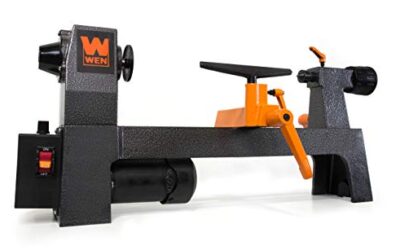
WEN LA3424
The LA3424 gives a small shop the joint-largest capacity in this group, 12 inches of swing and a full 18 inches between centers, in a package built around a simple five-speed belt drive. That simplicity is the point: there is no speed-control electronics to fail, and the five fixed speeds from 520 to 3400 RPM cover roughing, shaping, and finishing for most spindle and bowl work. The listing includes the centers, faceplate, and tool rest needed to start turning, plus an onboard holder that keeps them within reach. It is the pragmatic second lathe for a shop, or a first lathe bought against a tight equipment budget.
Specs
- Motor: 4.5-amp
- Speeds: 5 fixed speeds, 520, 900, 1400, 2150, and 3400 RPM
- Swing over bed: 12 inches
- Distance between centers: 18 inches
- Headstock and tailstock taper: MT2
- Tool rest: 8 inches
- Faceplate: 3-1/8 inches
- Item weight: 78.9 pounds
- Dimensions: 30.25 x 8.75 x 16.25 inches
- Includes MT2 spur center, live tailstock center, and onboard accessory holder
Best for: Shops needing 12 x 18 capacity and mechanical simplicity at the lowest equipment cost in this group.
Watch out for: Every speed change means moving the belt, which slows down work that alternates between roughing and finishing.
ASIN: B09XWRBJ95
RIKON 70-105
RIKON designed the 70-105 at the request of pen turners, and it shows in the details: a self-ejecting tailstock that speeds up blank changes, easy-access belt changes, and a compact cast-iron frame that keeps a dedicated small-parts station stable. The five speeds run from 500 to 3200 RPM, which covers boring pen barrels, roughing billets, and polishing finished barrels without drama. For a professional shop, its best role is as a specialized station: park it beside the drill press and pen assembly area so small-batch pen, bottle stopper, and finial work never queues behind the main lathe. The five-year warranty is the strongest coverage in this group.
Specs
- Motor: 1/2 HP TEFC, 120V, 3.7 amps
- Speeds: 5 ranges, 500, 1175, 1850, 2225, and 3200 RPM
- Swing over bed: 10 inches
- Distance between centers: 18 inches
- Spindle: 1 inch x 8 TPI
- Headstock and tailstock taper: MT2
- Tool rest: 6 inches
- Construction: cast iron bed, headstock, and tailstock
- Item weight: 74 pounds
- Warranty: 5 years
Best for: A dedicated pen-turning and small-parts station running alongside a larger main lathe.
Watch out for: Forward rotation only and a 1/2 HP motor, so it is not the machine for large or unbalanced bowl blanks.
ASIN: B01426DJ78
Which One Fits Your Situation
You turn bowls and spindles for paying customers every day
Choose the Delta Industrial 46-460. It has the strongest motor here, the largest swing, and reverse rotation for sanding, which together shorten the path from blank to finished piece. The JET is smoother at delicate work, but the Delta’s power reserve is what daily production actually consumes, especially on dense hardwoods and larger blanks that arrive out of round.
Your bench space is shared and the lathe must earn its corner
Pick the JET JWL-1015VS. Its footprint is the smallest of the four, yet the cast-iron build and 200 RPM low end let it handle careful bowl work that cheaper minis chatter through. The indexing head also lets it double as a routing and drilling station, which justifies the bench space in a shop where every surface has to serve two purposes.
You are equipping a second station or starting a turning side business
The WEN LA3424 is the sensible spend. It matches the Delta on swing and beats it on between-centers length, so almost no job in a small shop’s usual range is beyond it. The belt-changed speeds are a fair trade for the simpler drive, and the included centers and faceplate mean the first paying job does not wait on a tooling order.
Pens, stoppers, and small gift items are a product line, not a hobby
Set up the RIKON 70-105 as a permanent small-parts station. Its self-ejecting tailstock and pen-focused design keep batch work moving, and keeping this work off your main lathe frees that machine for bowls and spindles. The five-year warranty suits equipment that will run in short bursts all day, every day.
Common Mistakes
- Buying by swing alone and discovering the between-centers distance is too short for your longest regular product.
- Leaving the lathe unbolted on a light bench, then blaming the machine for chatter that comes from the setup.
- Ordering chucks and centers before confirming the spindle thread and taper stated on the listing.
- Choosing a belt-stepped lathe for work that constantly alternates between slow roughing and fast finishing.
- Skipping dust extraction planning: a benchtop lathe in a small shop fills the air with fine dust faster than a floor model in a large one.
Frequently Asked Questions
Is a benchtop lathe powerful enough for professional work?
Yes, within its capacity. The midi models here turn bowls to about 11 inches and spindles to 18 inches, which covers most small-shop product lines. Professional use is mainly about build quality and duty: cast-iron construction, a motor of at least 1/2 HP, and firm mounting matter more than raw size. Work beyond those dimensions is the point where a floor lathe becomes necessary.
What is the difference between a mini and a midi lathe?
Mini lathes typically offer around 10 inches of swing with lighter frames, while midi lathes step up to 12 or 12-1/2 inches of swing, heavier castings, and stronger motors. Both sit on a bench. For a professional shop, a midi is usually the primary machine and a mini earns its place as a dedicated station for pens and small parts, exactly the split used in the picks above.
Do I need variable speed, or are fixed speeds enough?
It depends on how varied your work is. Electronic variable speed pays off when one piece needs several speeds in sequence, such as roughing a bowl slowly and finishing it fast. Fixed belt speeds are enough for repetitive single-product work, like pens turned at one setting all day. Mixed production shops feel the time savings of a speed dial within the first week.
Can two different benchtop lathes share chucks and accessories?
Usually yes, provided both use the same spindle thread and taper. All four lathes in this guide use a 1-inch by 8 TPI spindle and MT2 tapers, so chucks, faceplates, drive centers, and drill chucks move between them freely. Always confirm those two figures on the product listing before ordering tooling, because a mismatched chuck insert is a common and avoidable expense.
Related guides
More from Amazon
Programs that pair well with the guide above. Offers and eligibility are set by Amazon and may change.
Free shipping on eligible items, Prime Video and more. Eligible new members can start with a free trial.
Start a Prime free trialAudiobooks and podcasts to listen to on the go. Eligible new members can start with a free trial.
Try Audible freeAd-free music streaming. Eligible new subscribers can start with a free trial.
Try Music Unlimited freeA free business account with business pricing and bulk-buying tools for work, shop or home office.
Create a business accountAs an Amazon Associate we earn from qualifying purchases.
Write Your Review
No reviews yet. Be the first to share your experience!