5 Best Benchtop Wood Lathes for Garages (November 2026)
Compare five benchtop lathes for garage workshops on swing, length between centers, motor and speed control, from an 8-inch mini to a 12-1/2-inch midi.
Compare five benchtop lathes for garage workshops on swing, length between centers, motor and speed control, from an 8-inch mini to a 12-1/2-inch midi.
As an Amazon Associate I earn from qualifying purchases. This post may contain affiliate links at no extra cost to you.
Choosing a benchtop lathe for a garage is a decision about capacity against bench space. Swing over the bed caps the diameter of bowls and platters you can mount, while the distance between centers caps spindle length, and both numbers grow quickly as projects move from pens toward table legs. Speed control matters just as much: electronic variable speed suits frequent diameter changes, while belt-stepped speeds trade convenience for simplicity. The five lathes below span 8 to 12-1/2 inches of swing, so the shortlist starts with the work you plan to turn.
OUR TOP PICK
WEN 3421 3.2-Amp 8 by 12 Inch Variable Speed Mini Wood Lathe
These picks serve distinct benches: a first-time turner learning on pens and bottle stoppers, a hobbyist ready for small bowls, and a garage woodworker who needs midi capacity without giving up a parking space to a floor lathe. Every model was selected from the names and specifications published on its Amazon product page, and the specs quoted here come only from those listings, including where a listing leaves a figure unstated.
Quick Picks
As an Amazon Associate we earn from qualifying purchases.
Product
Best for
Key spec from title
WEN 3421
First lathe on a tight bench
3.2-Amp, 8 by 12 inch, variable speed
JET JWL-1015VS
Bowls with indexing on cast iron
10 by 15 inch, 1/2 HP, cast iron
RIKON 70-105
Longer spindles on a 10-inch swing
10 by 18 inch, 1/2 HP mini lathe
WEN LA3424
A 12-inch swing for wider work
4.5-Amp, 12 by 18 inch, 5-speed
Delta 46-460
Midi capacity with a 1 HP motor
12-1/2-inch variable-speed midi lathe
How to Choose
Match Swing and Between-Centers Capacity to Your Projects
Swing is the largest diameter that clears the bed, and it decides whether your blanks become bowls or stay spindle-only. An 8-inch swing handles pens, stoppers and small boxes; 10 inches opens up salad bowls and platters; 12 inches or more suits the wider faceplate work many garage turners grow into. Between-centers distance sets the longest spindle you can mount, from 12 inches on the smallest pick here to 18 inches on the longest. Measure the projects you truly expect to turn, then buy the smallest capacity that covers them, because every extra inch also adds bench footprint and weight.
Decide How You Want to Change Speed
Electronic variable speed lets you slow down for roughing a bowl blank and speed up for finishing cuts without stopping the lathe, which matters when one piece passes through several diameters in a single session. Belt-stepped lathes make you move a belt between pulleys to change ranges, a pause that spindle turners working at one size rarely mind. Ranges matter too: a low end near 250 to 750 RPM keeps large, unbalanced blanks under control, while a top end above 3,000 RPM suits pens and small-diameter work. Match the control style to how often your projects change diameter.
Check Spindle Thread and Taper Compatibility
Accessories decide whether a lathe stays cheap to own. Chucks, faceplates and drive centers must match the spindle thread, stated as 1 inch by 8 TPI on the JET and Delta picks here, and the tapers must match too: the small WEN 3421 uses MT1 at both ends while the JET, Delta and WEN LA3424 state MT2. Confirm fit before reusing gear from another machine. Indexing is worth a look as well: the JET adds a 24-position indexing headstock for layout work such as fluting and drilling patterns on turned pieces.
Weigh the Bench, the Motor and What Is Included
A benchtop lathe only behaves if the bench under it stays put, so weight is a feature rather than a nuisance: cast iron beds on the JET, RIKON and Delta damp vibration, and the two heavier picks here top 70 lb. Motor ratings arrive in mixed units, amps on the WEN models and horsepower on the JET, RIKON and Delta, so compare within each style instead of across them. Finally, inventory the box before ordering extras: tool rests, faceplates, live and spur centers and knockout bars vary by model, and every pick here includes a different bundle.
The 5 Best Options
WEN 3421 3.2-Amp 8 by 12 Inch Variable Speed Mini Wood Lathe
Top Pick
WEN 3421 3.2-Amp 8 by 12 Inch Variable Speed Mini Wood Lathe
Best for: First-time turners learning on pens and small spindle projects on a crowded bench.
First-time turners learning on pens and small spindle projects on a crowded bench.
Watch out for
The MT1 tapers and 8-inch swing cap accessory and project size quickly, so confirm that any chuck or center you plan to add is MT1 and sized for small work.
The WEN 3421 is the smallest lathe in this group and the natural starting point for a garage bench that also has to hold everything else. Its 8-inch swing and 12 inches between centers cover pens, bottle stoppers, honey dippers and other small spindle work, while the soft-start variable speed runs from 750 to 3,200 RPM, so beginners can slow down for rough cuts and speed up for sanding without touching a belt. The MT1 tapers at both ends keep accessories compact and matched to the machine’s scale, and the included 2.3-inch face plate opens up small faceplate projects straight from the box.
Watch out for: The MT1 tapers and 8-inch swing cap accessory and project size quickly, so confirm that any chuck or center you plan to add is MT1 and sized for small work.
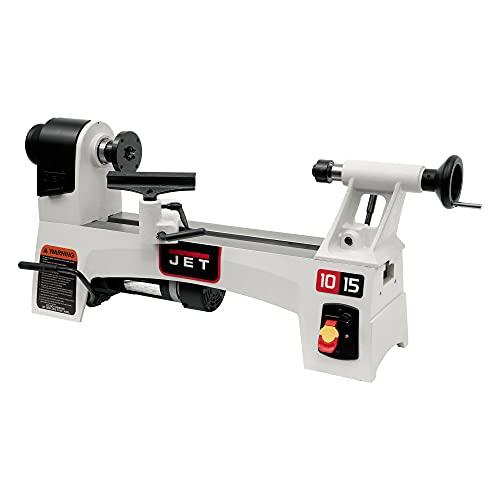
JET JWL-1015VS 10 by 15 Inch Variable Speed Wood Lathe
Runner-Up
JET JWL-1015VS 10 by 15 Inch Variable Speed Wood Lathe
Best for: Bowl and spindle turners who want indexing and a wide electronic speed range on a cast iron bench lathe.
Motor: 1/2 HP DC, 115V single phase; 4 A per the listing spec table
Swing: 10 inches
Between centers: 15-1/2 inches
Speed: three-range electronic variable speed, 200 to 3,600 RPM
Bowl and spindle turners who want indexing and a wide electronic speed range on a cast iron bench lathe.
Watch out for
The listing disagrees with itself on amperage, stating 4 A in the spec table but 3.2 A in the description text, so confirm the rating on the motor plate before wiring it into a shared garage circuit.
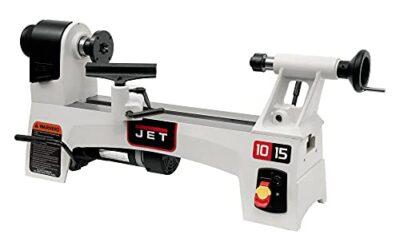
The JET JWL-1015VS suits turners who have outgrown a mini lathe but still need the machine to live on a bench. A cast iron bed, headstock and tailstock give the 10-inch swing real stability, and the three-range electronic variable speed covers 200 to 3,600 RPM, low enough for unbalanced bowl blanks and high enough for fine spindle detail. The 24-position indexing headstock adds layout options that belt-driven rivals here do not offer, and the box includes both centers, a knockout rod, a 6-inch tool support and a 3-inch face plate, so the lathe arrives ready to turn.
Watch out for: The listing disagrees with itself on amperage, stating 4 A in the spec table but 3.2 A in the description text, so confirm the rating on the motor plate before wiring it into a shared garage circuit.
RIKON 70-105 10 by 18 Inch Mini Lathe
The RIKON 70-105 stretches spindle capacity further than the other 10-inch lathe here, with 18 inches between centers for chair rungs, tool handles and longer blanks. Speed changes come from moving the belt across five steps, an easy-access arrangement that keeps the machine simple and repairable, and the self-ejecting tailstock speeds up swapping centers between jobs. Cast iron construction keeps the lathe planted during roughing cuts, and the included live center, tool rest, knock-out bar and wrenches cover the basics. Note that the listing does not publish the five speed values, so expect stepped rather than dialed control.
Specs
Motor: 1/2 HP
Swing: 10 inches
Between centers: 18 inches
Speed: five belt-change speeds (the listing does not state the RPM values)
Tailstock: self-ejecting
Construction: cast iron
Included: live center, tool rest, knock-out bar, wrenches
Dimensions: 35.5 by 10.5 by 14.75 inches
Best for: Spindle turners who need 18 inches between centers for furniture parts and long handles.
Watch out for: The listing never states the five RPM values or the machine’s weight, so check both on the product page if a specific low speed or a one-person bench move matters to you.
WEN LA3424 4.5-Amp 12 by 18 Inch 5-Speed Benchtop Wood Lathe
WEN LA3424 4.5-Amp 12 by 18 Inch 5-Speed Benchtop Wood Lathe
Best for: Turners stepping up to 12-inch bowls and longer spindles who accept belt changes for speed.
Motor: 4.5-Amp
Swing: 12 inches
Between centers: 18 inches
Speed: five belt-and-pulley speeds, 520, 900, 1,400, 2,150 and 3,400 RPM
Turners stepping up to 12-inch bowls and longer spindles who accept belt changes for speed.
Watch out for
Speed changes mean stopping to move the belt between pulleys, and the 70-plus-pound body is a two-person lift onto a high bench, so plan the setup before it arrives.
The WEN LA3424 brings a 12-inch swing and 18 inches between centers to a bench-friendly footprint, which makes it the capacity step-up for turners eyeing wider bowls and longer spindles. Its 4.5-Amp motor drives five belt-and-pulley speeds from 520 to 3,400 RPM, and the MT2 headstock and tailstock tapers match the accessory standard stated by the larger lathes in this roundup. An 8-inch tool rest, a 3-1/8-inch faceplate and an onboard accessory holder are included, and at more than 70 lb the machine stays settled when a rough blank starts out of balance.
Watch out for: Speed changes mean stopping to move the belt between pulleys, and the 70-plus-pound body is a two-person lift onto a high bench, so plan the setup before it arrives.
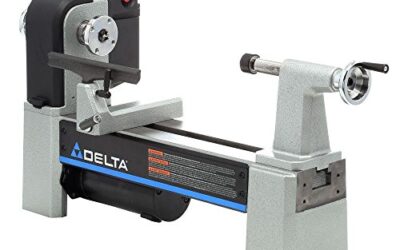
The Delta 46-460 is the heavyweight pick, a midi lathe with a 1 HP motor, 12-1/2 inches of swing over the bed and the widest speed span here, running from 250 to 4,000 RPM across three pulley ranges with electronic control. The patented belt tensioning system makes range changes quicker than on plain stepped lathes, and the 16-1/2 inches between centers can grow to 42 inches with a bed extension for the occasional long spindle. Two tool rests, 6 and 10 inches, plus a 3-inch face plate come in the box, and the all cast-iron build suits turners who rough out green bowls.
Specs
Motor: 1 HP, 120V, 60 Hz, 12 A
Swing: 12-1/2 inches over the bed; 9-9/16 inches over the base
Between centers: 16-1/2 inches (42 inches with bed extension)
Speed: electronic variable speed in three pulley ranges, 250-700, 600-1,800 and 1,350-4,000 RPM
Spindle: 1 inch by 8 RH TPI; MT2 headstock and tailstock tapers
Tailstock travel: 2-1/4 inches
Included: 6-inch and 10-inch tool rests, 3-inch face plate
Dimensions: 36 by 11 by 17.75 inches
Best for: Experienced turners who want midi capacity, a 1 HP motor and the widest speed span for green-wood bowls.
Watch out for: Copies of this listing disagree on stock, with one showing only a few left and another showing it out of stock, so confirm a live buy option on the product page before planning a project around this lathe.
Which One Fits Your Situation
Your Bench Is a Shared Garage Worktop
If the lathe shares space with a mower, bikes and a workbench that still has to park a car, start small. The WEN 3421 covers pens and small spindle work in the least room, while the JET JWL-1015VS is the step up when the bench can spare more depth and you want cast iron stability without a midi footprint.
You Turn Mostly Pens and Small Spindles
Pen blanks, stoppers and honey dippers never test a big swing, so prioritize fine speed control and quick setup instead. The WEN 3421 dials from 750 to 3,200 RPM with a soft start, and the JET adds a lower 200 RPM bottom end plus indexing if your small work grows into bowls and patterned pieces later.
Bowls Are Becoming the Main Event
Diameter and low-speed control decide bowl work. The Delta 46-460 pairs a 12-1/2-inch swing with a 250 RPM low end for roughing unbalanced blanks, and the WEN LA3424 offers the same 12-inch class of swing with five fixed speeds. The JET’s 200 RPM floor and indexing suit smaller bowls with decorative layout work.
You Need Length for Furniture Parts
Chair rungs, handles and lamp bases reward distance between centers. The RIKON 70-105 and the WEN LA3424 both reach 18 inches, the longest here, while the Delta stretches from 16-1/2 inches to 42 inches with a bed extension. Check the extension’s fit and availability before counting on that extra length for a project.
Common Mistakes
Buying swing you will never use: a 12-inch lathe on a light bench vibrates more and crowds the garage, so match capacity to the blanks you actually buy.
Assuming every accessory fits: MT1 and MT2 tapers and different spindle threads are not interchangeable, so check your existing centers and chucks against the new lathe before ordering.
Reading the between-centers figure as usable spindle length without allowing room for the drive center, live center and tool rest position.
Comparing motor ratings across units: amps on one brand and horsepower on another describe different things, so judge power within each rating style and by the work you turn.
Skipping the included-accessories list and rebuying a faceplate or tool rest that was already in the box.
Frequently Asked Questions
What size lathe do I need for turning bowls?
Swing over the bed is the ceiling: the blank must be smaller than the swing to rotate. An 8-inch lathe limits you to small bowls and boxes, 10 inches covers most salad bowls, and the 12 to 12-1/2-inch picks here handle wider platters and green-wood blanks. Also check swing over the tool rest base, which is lower on some models.
Is electronic variable speed worth it on a benchtop lathe?
For mixed work, yes: changing diameter mid-piece is constant in bowl turning, and a dial avoids stopping to move a belt. The JET and Delta here pair electronic control with pulley ranges, while the WEN 3421 is fully dial-driven. Belt-stepped lathes like the RIKON and WEN LA3424 cost less complexity and suit spindle work at steady sizes.
Can a benchtop lathe turn table legs and other long spindles?
Only within its between-centers length. The longest picks here reach 18 inches, enough for chair rungs, handles and short legs, while full table legs usually need more. The Delta 46-460 is the exception worth checking: its listing states 16-1/2 inches between centers, growing to 42 inches with a bed extension fitted.
What is the difference between MT1 and MT2 tapers?
The Morse taper size decides which centers, drill chucks and mandrels fit the headstock and tailstock. The WEN 3421 uses MT1 at both ends, suiting its compact scale, while the JET, Delta and WEN LA3424 listings state MT2 tapers. The two sizes are not interchangeable, so inventory your existing accessories before choosing a lathe.
A
admin88
We compare specs, warranty terms, long-term owner feedback and street pricing before anything earns a spot. Rankings are never paid.
Affiliate disclosure. As an Amazon Associate we earn from qualifying purchases at no extra cost to you. Prices accurate as of the date shown.
Benchtop wood lathes with reverse rotation compared on swing, distance between centers, speed ranges, motor power and spindle thread, from the listings.
Compare the best benchtop wood lathes with digital speed displays, from compact midi lathes to heavy-duty models that dial in exact RPMs for every turn.
Compare the best benchtop wood lathes for small professional workshops, with cast-iron midi and mini models, variable speed and honest capacity figures.
Compare WiFi pellet grills by cooking area, hopper size and app control, from Traeger and Camp Chef to Pit Boss, and pick the right size for your cooks.
Compare five midi wood lathes for a garage workshop by swing, distance between centers, motor power and speed control, with full published specs for each.
Compare the best closed-frame portable generators with electric start by running watts, noise, fuel options and outlets to choose the right quiet inverter.
Compare five pressurized pond filters with UV clarifiers by flow, size and cleaning, so pond water stays clear without constant scrubbing or cloudy weeks.
Compare the best bead pond filters for backyard fish ponds by pond size, flow rate, and backwash design, with picks for ponds from 2,000 to 8,000 gallons.



Write Your Review
No reviews yet. Be the first to share your experience!