
Key takeaways
- Compare three portable plasma cutters for mobile contractors: dual-voltage input, pilot arc starts and clean-cut ratings from each Amazon listing.
What's inside
As an Amazon Associate I earn from qualifying purchases. This post may contain affiliate links at no extra cost to you.
A mobile contractor does not get to choose the metal, the power, or the weather at the next job. The real decision behind a portable plasma cutter is whether one compact inverter machine can ride in the truck, run off whatever outlet or generator the site offers, and still start an arc on rusty, painted steel without dragging the tip across it. Cut capacity on the box matters less than that combination of dual-voltage input, a non-touch arc start, and a duty cycle that survives a full gate repair or a run of brackets.


This roundup is for mobile welders, maintenance contractors, and farm and fleet repair crews who cut where the work is. Every machine below is a portable inverter plasma cutter sold on Amazon, and each one was chosen from the name and specifications printed on its own listing, so the amperage, voltage, and thickness figures here match what the product page itself claims.
Quick Picks
As an Amazon Associate we earn from qualifying purchases.
| Product | Best for | Key spec from title |
|---|---|---|
| YESWELDER CUT-55DS NHF PLUS | Crews cutting dirty or painted steel near electronics | 55A non-HF pilot arc, 110/220V |
| bestarc BTC500DP 9GEN | Contractors who cut mesh, grating, and repair plate all day | 50A pilot arc with adjustable arc timer |
| LOTOS LT5000D | Budget-minded crews that still need real severance capacity | 50A, 5/8 inch clean cut, dual voltage |
How to Choose
Match the clean-cut rating to the metal you actually cut
Listings print three different thicknesses: a clean or rated cut, a maximum cut, and a severance cut that leaves a rough edge you will grind anyway. Plan your purchase around the clean-cut number, because that is the thickness the machine separates in one pass at a reasonable travel speed. A contractor who mostly cuts 3/8 inch brackets, square tube, and sheet for patch panels is well served by a 50-amp class machine. If structural plate and 1/2 inch mild steel show up weekly, step up in amperage rather than trusting a severance figure.
Dual voltage decides where the machine can work
Job sites rarely offer the outlet you want. A dual-voltage 110/220V machine runs at reduced output from an ordinary receptacle for light sheet and trim work, then delivers its full amperage on 220V for plate. Check how the listing handles the switch: automatic sensing with a plug adapter is faster in the field than a manual selector you can set wrong. Remember that full output on the low-voltage side is not available, so a machine rated 55 amps may only give you roughly half to two thirds of that on 110V, which changes what it can cleanly cut.
Pilot arc starting earns its keep on dirty metal
Site metal is rusty, painted, oily, or all three. A non-touch pilot arc starts the arc in the air above the surface, so the torch does not need clean bare metal or physical contact to fire, and consumables last longer because the tip is not dragged. High-frequency pilot arc versions work well but can interfere with nearby electronics, which is why non-HF designs exist for crews working around CNC equipment, vehicle modules, or office-adjacent repairs. If most of your cutting is expanded metal or grating, look for an adjustable pilot arc timer that keeps the arc alive between strands.
Air supply and duty cycle are the hidden limits
Every machine here needs an external air compressor, and the listing’s air requirement in CFM at a stated pressure is as important as amperage. A small jobsite pancake compressor may start the arc but starve it mid-cut on thick plate, leaving a beveled, slag-heavy edge. Duty cycle matters the same way: 60 percent at full output means six minutes of cutting in a ten-minute window before the machine needs to cool. Long demo cuts and production-style repetition hit that ceiling fast, so match both numbers to your compressor and your longest typical cut.
The 3 Best Options
YESWELDER CUT-55DS NHF PLUS
This is the pick for contractors who cut around sensitive electronics, because its non-high-frequency pilot arc starts without the burst of interference that HF machines can throw into nearby controls. The 55-amp output and dual-voltage input cover the usual mobile mix: light sheet and duct on a standard outlet, then 1/2 inch plate work when 220V is available. The listing also describes a 4-in-1 multifunction design with plate and grid cutting modes plus gouging, which suits repair work where one machine has to handle cutting, weld removal, and marking in the same visit.
Specs
- Output: 55 amps
- Input: 110/220V dual voltage
- Arc start: non-touch pilot arc, non-high-frequency design
- Clean cut: 1/2 inch
- Duty cycle: 60 percent
- Display: large LED digital display
- Functions: 4-in-1 multifunction with plate and grid cutting modes
Best for: Mobile crews cutting rusty or painted steel near vehicle electronics, CNC gear, or finished interiors.
Watch out for: Full 55-amp output needs 220V; on 110V the output and clean-cut capacity drop, so confirm your site power before planning thick cuts.
ASIN: B0FM87FYQ9
bestarc BTC500DP 9GEN
Contractors who spend their days on expanded metal, grating, and patch panels will appreciate this machine’s adjustable pilot arc. The listing lets you extend the pilot arc timing up to 15 seconds, which keeps the arc established while you cross gaps in mesh instead of restriking at every strand, while shorter settings preserve consumables on solid plate. It is a 50-amp dual-voltage unit with a screen display, an air sensor, and 2T/4T torch control, so long cuts can run without holding the trigger the whole time. Post-flow cooling after each cut also helps the torch survive back-to-back field work.
Specs
- Output: 50 amps
- Input: 110/220V dual voltage
- Arc start: high-frequency non-touch pilot arc
- Pilot arc timer: adjustable up to 15 seconds
- Torch control: 2T/4T modes with post-flow cooling
- Display: screen display with air sensor
- Torch: AG60P pilot arc torch
Best for: Maintenance and repair contractors cutting mesh, grating, and rusted plate where restarts eat time.
Watch out for: The high-frequency start can bother sensitive electronics nearby, and the AG60P consumable style should be stocked on the truck before the first job.
ASIN: B0D7CLNPWD
LOTOS LT5000D
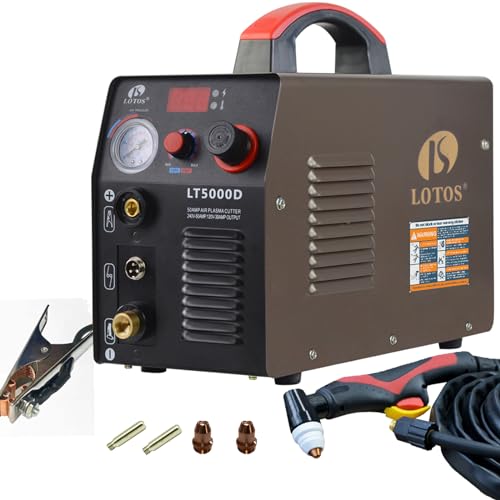
The LT5000D has been the default budget field cutter for years, and the current upgraded listing is rated for a 5/8 inch clean cut with a 3/4 inch severance cut, which is generous headroom for a 50-amp machine in this class. Dual-voltage input lets it run from shop or site power, and the compact inverter build keeps it easy to move between the truck, the scaffold, and the work. For a contractor who needs a capable cutter that can be replaced without drama if a site is hard on equipment, this is the straightforward choice, provided you plan around the clean-cut rating rather than the severance number.
Specs
- Output: 50 amps
- Input: dual voltage, 120V or 240V
- Clean cut: 5/8 inch (16 mm)
- Severance cut: 3/4 inch (20 mm)
- Duty cycle: 60 percent at 50 amps
- Design: inverter plasma cutter, 2024 upgraded model
Best for: Budget-conscious mobile crews that still need genuine 1/2 inch class cutting for repairs and fabrication.
Watch out for: The severance figure is a rough, slow cut; treat 5/8 inch as the working ceiling, and confirm your compressor can hold the required air flow on long cuts.
ASIN: B004VFJL14
Which One Fits Your Situation
You cut around vehicles, controls, or finished spaces
Choose the YESWELDER CUT-55DS NHF PLUS. Its non-HF pilot arc removes the interference worry that comes with high-frequency starts near engine control modules, CNC controls, and building electronics, and the non-touch start fires cleanly on the painted and rusted surfaces that dominate repair work. The 4-in-1 functions also reduce how much gear rides along.
Your work is mesh, grating, and patch panels
Choose the bestarc BTC500DP 9GEN. The adjustable pilot arc timer, up to 15 seconds, is built for exactly this: crossing the voids in expanded metal without constant restrikes, then shortening the timer on solid plate to save electrodes. The 2T/4T control and post-flow cooling make repetitive short cuts less tiring over a long shift.
You need one truck cutter for general repair work
Choose the LOTOS LT5000D. Its 5/8 inch clean-cut rating covers most brackets, tube, and plate a mobile crew meets, the dual-voltage input handles whatever the site offers, and the long-running model line means consumables and torches are easy to source. It is the simplest fit for mixed repair and light fabrication.
Your sites only offer standard household outlets
Any of the three will run on the lower voltage setting, but set expectations first: output and clean-cut thickness fall on 110V or 120V input. For thin sheet, duct, and trim, that is fine. For regular 1/2 inch plate, pick the machine with the highest amperage, the YESWELDER, and arrange 220V access whenever the job allows it.
Common Mistakes
- Buying by the severance or maximum thickness instead of the clean-cut rating, then discovering the machine only rough-cuts your everyday material.
- Bringing a compressor that cannot sustain the listing’s CFM requirement, which causes weak arcs, heavy dross, and premature consumable wear.
- Running full-output cuts on 110V and blaming the machine, when the listing’s full amperage is only available on 220V.
- Ignoring duty cycle on demolition or repetitive cutting, so the machine thermal-cycles and shuts down mid-job.
- Forgetting spare tips and electrodes on the truck; a pilot arc machine with worn consumables cuts like a broken one.
Frequently Asked Questions
Can a portable plasma cutter run from a generator?
Yes, provided the generator’s continuous output comfortably exceeds the cutter’s input draw and produces clean power. Inverter cutters are sensitive to voltage spikes, so an inverter generator or a unit with automatic voltage regulation is the safer pairing. Always size the generator for the cutter at full amperage on 220V, not for the reduced draw on the low-voltage setting, or the arc will stumble on thick cuts.
Do these machines cut aluminum and stainless, or only mild steel?
Plasma cuts any electrically conductive metal, and all three listings cover stainless steel, alloy steel, mild steel, copper, and aluminum. Expect the practical clean-cut thickness to drop on aluminum and copper compared with mild steel, because those metals conduct heat away from the cut faster. Cut quality also depends on dry, clean air, so a moisture separator on the compressor line helps on non-ferrous work.
What air compressor does a mobile contractor need for one of these cutters?
You need a compressor that delivers the CFM at the pressure stated on the machine’s listing, continuously, not just at peak. Small pancake compressors often fall short on long cuts in thick plate, causing the arc to fade. A mid-size jobsite compressor with a larger tank is the practical minimum, and draining the tank daily keeps moisture out of the torch and extends consumable life.
Is pilot arc worth it for field work?
For site work, usually yes. Pilot arc starts without touching the tip to the metal, so it fires through rust, paint, and mill scale that stop a drag start, and it restarts across the gaps in mesh and grating. The trade-off is slightly higher consumable cost and, on high-frequency versions, possible interference with nearby electronics. Crews working around controls should pick a non-HF design like the YESWELDER in this list.
Related guides
More from Amazon
Programs that pair well with the guide above. Offers and eligibility are set by Amazon and may change.
Free shipping on eligible items, Prime Video and more. Eligible new members can start with a free trial.
Start a Prime free trialAudiobooks and podcasts to listen to on the go. Eligible new members can start with a free trial.
Try Audible freeAd-free music streaming. Eligible new subscribers can start with a free trial.
Try Music Unlimited freeA free business account with business pricing and bulk-buying tools for work, shop or home office.
Create a business accountAs an Amazon Associate we earn from qualifying purchases.
Write Your Review
No reviews yet. Be the first to share your experience!