
Key takeaways
- Compare portable plasma cutters for small metalworking shops: pilot arc starts, dual 110/220V input, clean-cut ratings and duty cycles from each listing.
What's inside
As an Amazon Associate I earn from qualifying purchases. This post may contain affiliate links at no extra cost to you.
The real decision when a small metalworking shop buys a portable plasma cutter is not peak amperage. It is whether the machine cuts the plate thickness you actually run every week, on the power your building already has, without outrunning your air compressor. A cutter that severs thick stock once but trips breakers or waits on air all day costs more time than it saves.
This guide is for fabrication and repair shops cutting sheet, brackets and plate up to about 5/8 inch, for maintenance benches that need one machine to move between bays, and for shops adding a first plasma cutter beside an oxy-fuel torch. Every pick below was chosen from the specifications printed on its Amazon product page: output range, clean-cut and severance ratings, input voltage, duty cycle and weight.
Quick Picks
As an Amazon Associate we earn from qualifying purchases.
| Product | Best for | Key spec from title |
|---|---|---|
| LOTOS LTP5800D | All-round shop cutting on either voltage | 58A non-touch pilot arc, 110V/220V |
| YESWELDER CUT-60DS PRO | The thickest plate in this group | 60A blowback pilot arc, digital display |
| bestarc BTC500DP | Painted or rusty stock with visible air pressure | 50A pilot arc, air sensor, LED display |
| ARCCAPTAIN CUT50 | Carrying the cutter to the work | 50A, 1/2 inch clean cut, about 13 lb |
How to Choose
Size the machine by clean cut, not severance
Listings print two thickness numbers, and they mean different things. The clean-cut rating is the thickness the machine cuts at a reasonable travel speed with an edge that needs little grinding. The severance rating is the thickest stock it can push through slowly, leaving a rough edge. A shop that cuts 3/8 inch plate daily should shop by the clean-cut figure at its working voltage and treat severance as an occasional escape hatch, not the working spec. Buying against the severance number is how shops end up with a machine that feels underpowered from day one.
Know what dual voltage gives up on 120V
Every machine here runs on 110/120V or 220/240V, but none of them makes full power on the lower voltage. Output typically drops by roughly a third: the LOTOS below caps at 35 amps on 120V against 58 amps on 240V, and its clean-cut rating falls with it. Dual voltage is best read as flexibility, not equality. It lets the cutter travel to a job or run before a 240V circuit is installed, but a shop cutting plate all week should still plan on the higher-voltage circuit for rated performance.
Pick the pilot arc type that suits your work
A pilot arc starts the arc without the torch tip touching the metal, which matters on painted, rusty or expanded stock where a contact start struggles. Two systems appear in this group. High-frequency pilot arc, used by the bestarc, is common and effective but can disturb sensitive electronics nearby. Blowback, or non-high-frequency, starting on the YESWELDER moves the electrode inside the torch instead, so it starts cleanly around CNC controls and shop computers. If your cutting is mostly clean flat plate, either works; the surface condition of your stock should decide.
Match air supply and duty cycle to your pace
Plasma cutters consume shop air the whole time they cut, and post-flow air keeps cooling the torch after each cut. Check the listing’s recommended inlet pressure against what your compressor holds at the tool, not its tank rating. Duty cycle then tells you how the machine paces out: 60 percent at full output means six minutes of cutting in a ten-minute window before it needs to cool. Short bracket work never notices this. Long rip cuts in plate do, so shops planning long seams should weight duty cycle as heavily as amperage.
The 4 Best Options
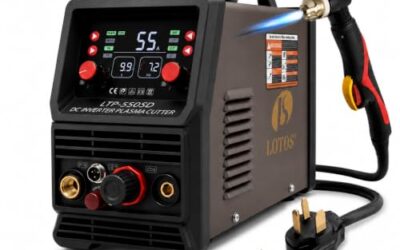
LOTOS LTP5800D

The LTP5800D is the balanced pick for a small shop that cuts a bit of everything. Its 58-amp output tops the 50-amp class without moving into a heavy cabinet machine, and the non-touch pilot arc starts on painted or rusty stock without grinding a clean spot first. The front panel shows air pressure and settings on an LED display, pilot arc time and post-flow are adjustable, and at about 14 pounds with its torch it still moves between benches easily. On 240V it carries the strongest clean-cut rating in this group.
Specs
- Output current: 10-58A
- Input: 120/240V dual voltage, single phase, 50/60 Hz
- Clean cut: 5/8 inch on 240V; 3/8 inch on 120V
- Severance cut: 3/4 inch on 240V; 1/2 inch on 120V
- Duty cycle: 60 percent at 58A on 240V; 60 percent at 35A on 120V
- Arc start: non-touch pilot arc, adjustable pilot arc and post-flow times
- Weight: 14.1 lb with torch
Best for: Shops wanting one portable cutter that covers sheet through 5/8 inch plate on 240V.
Watch out for: Full output needs the 240V circuit; on 120V the machine caps at 35A, so check your panel before planning thick cuts.
ASIN: B092338HHS
YESWELDER CUT-60DS PRO

This is the most powerful machine in the group, with 60 amps on tap and a blowback, non-high-frequency start that will not spray interference into nearby electronics. The non-touch pilot arc works through paint and rust, the digital display shows the settings instead of leaving you to guess from a dial position, and post-flow adjusts from 5 to 20 seconds for longer cuts. It is also the heaviest pick here, so it suits a cutter that lives on a cart and rolls around one shop rather than riding in a truck daily.
Specs
- Output current: up to 60A
- Input: 110/220V dual voltage, auto-sensing
- Arc start: non-high-frequency blowback, non-touch pilot arc, IPT40 torch
- Clean cut: rated about 5/8 inch on 240V per the listing
- Duty cycle: 60 percent at 46A on 220V; 60 percent at 40A on 110V
- Post-flow: adjustable 5-20 seconds, with PT, 2T and 4T functions
- Weight: 21.4 lb
Best for: Shops cutting thicker plate regularly that want a non-HF start near other electronics.
Watch out for: Listing details mix CUT-60DS PRO and CUT-65DS naming across variants, so confirm the exact style selected before ordering.
ASIN: B09L3Y3ZLF
bestarc BTC500DP

The BTC500DP builds its case around control feedback. Alongside the 50-amp output and high-frequency pilot arc, it adds an air sensor with the pressure shown on a large LED display, so a starving compressor shows up on the panel before it shows up as a bad edge. The listing rates a 1/2 inch clean cut and up to a 4/5 inch maximum cut, pilot arc time adjusts up to 15 seconds for mesh and expanded metal, and 2T/4T modes take the strain off your trigger finger on longer cuts.
Specs
- Output current: up to 50A
- Input: 110/220V dual voltage
- Arc start: high-frequency non-touch pilot arc, adjustable up to 15 seconds
- Clean cut: 1/2 inch; maximum cut 4/5 inch
- Recommended maximum: 12 mm at 35A on 110V; 20 mm at 50A on 220V
- Display: large LED with air sensor and built-in air filter regulator
- Modes: post-flow, mesh cutting, 2T/4T
Best for: Shops cutting painted, rusty or expanded stock that want air pressure visible at a glance.
Watch out for: Several generations share the BTC500DP name, so confirm the generation on the listing matches the features you expect.
ASIN: B0D7CR3YLC
ARCCAPTAIN CUT50
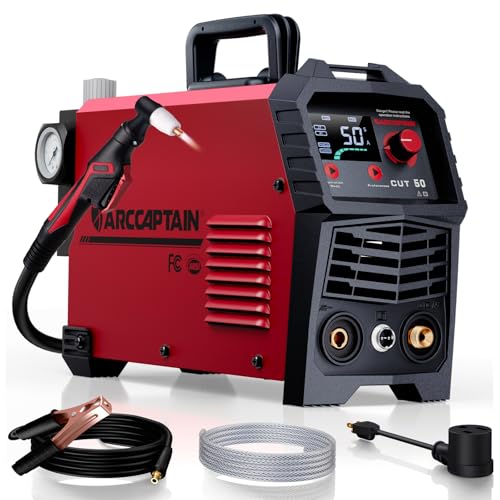
At roughly 13 pounds, the CUT50 is the machine here that genuinely earns the word portable. It is a 50-amp IGBT inverter cutter with automatic dual voltage, a large LED display, adjustable post-flow and 2T/4T trigger modes, and the listing rates it for a 1/2 inch clean cut. A metal-cased air filter comes pre-installed with a standard 1/4 inch NPT fitting, so setup on a shop compressor is quick. For a small shop whose cutting is mostly sheet, tube and light plate, it covers the work without the weight or the circuit demands of the bigger units.
Specs
- Output current: up to 50A
- Input: 110/220V dual voltage, automatic switching
- Clean cut: 1/2 inch per the listing title
- Maximum cut: about 18 mm at 220V per the listing
- Duty cycle: 60 percent at 50A
- Display: large LED, with post-flow control and 2T/4T modes
- Weight: about 13 lb
Best for: Mobile repair work and small shops cutting mostly sheet and light plate.
Watch out for: The 1/2 inch clean-cut rating applies on 220V; expect thinner clean cuts on a 110V outlet.
ASIN: B0B5N7K2DJ
Which One Fits Your Situation
You cut plate up to 5/8 inch most weeks
Start with the LOTOS LTP5800D or the YESWELDER CUT-60DS PRO, and plan on a 240V circuit either way. The LOTOS is lighter and simpler to live with; the YESWELDER adds a non-high-frequency start and a longer post-flow range. Both lose real capacity on 120V, so treat the lower voltage as a stopgap.
Your stock arrives painted, rusty or expanded
Choose between the bestarc BTC500DP and the YESWELDER, the two picks that pair a pilot arc with feedback or a non-HF start. The bestarc shows air pressure on its display, which helps diagnose rough cuts. The YESWELDER’s blowback start is the safer neighbour for electronics. Either starts without grinding a bare patch first.
The cutter has to travel between jobs
Take the ARCCAPTAIN CUT50. At about 13 pounds with automatic dual voltage, it runs wherever there is an outlet and a small compressor, and its clean-cut rating still covers sheet and light plate. The LOTOS is the step up if the travel jobs regularly include thicker stock and you can accept a little more weight.
This is your shop’s first plasma cutter
The LOTOS LTP5800D is the forgiving starting point: mid-range output, clear display, adjustable post-flow and a clean-cut rating with headroom over thin work. Buyers who already know they will cut mesh or expanded metal often should look at the bestarc instead, since its pilot arc time adjusts for exactly that work.
Common Mistakes
- Sizing the machine by its severance rating instead of the clean-cut rating at your voltage.
- Running a dual-voltage cutter on 120V and expecting the full published thickness capacity.
- Feeding the torch wet or under-pressured air because the compressor’s tank gauge looked fine.
- Ignoring duty cycle, then blaming the machine for thermal shutdowns during long rip cuts.
- Forgetting that consumables are model-specific, and ordering spares that fit a different torch.
Frequently Asked Questions
How thick can a 50-amp plasma cutter really cut?
Going by the listings here, a 50-amp machine clean-cuts about 1/2 inch of steel on 220/240V and can sever somewhat thicker stock slowly with a rougher edge. On 110/120V both numbers fall. Judge a machine by the clean-cut figure for the voltage you will actually use.
Do I need a pilot arc for a small fabrication shop?
It depends on your stock. Clean, flat plate starts fine without one, but painted, rusty or expanded metal interrupts a contact arc and wears consumables faster. Three of the four machines here include a pilot arc, and for mixed repair work that flexibility is usually worth having.
What size air compressor do these cutters need?
Each listing states a recommended inlet pressure, roughly 45 to 65 psi depending on the machine and voltage, and the compressor must hold that pressure at the torch while cutting, not just fill its tank to it. Dry air matters too, which is why several of these machines build a filter regulator into the case.
Can one of these replace an oxy-fuel torch entirely?
For cutting steel plate, sheet and non-ferrous metals, a plasma cutter is faster and leaves a narrower kerf. Oxy-fuel still wins for heating, bending and brazing, and it needs no electricity or compressed air. Many small shops keep both and reach for plasma whenever the job is cutting alone.
Related guides
More from Amazon
Programs that pair well with the guide above. Offers and eligibility are set by Amazon and may change.
Free shipping on eligible items, Prime Video and more. Eligible new members can start with a free trial.
Start a Prime free trialAudiobooks and podcasts to listen to on the go. Eligible new members can start with a free trial.
Try Audible freeAd-free music streaming. Eligible new subscribers can start with a free trial.
Try Music Unlimited freeA free business account with business pricing and bulk-buying tools for work, shop or home office.
Create a business accountAs an Amazon Associate we earn from qualifying purchases.
Write Your Review
No reviews yet. Be the first to share your experience!