
Key takeaways
- Compare benchtop wood lathes with variable speed controls on swing, motor, speed range and spindle thread to pick the right midi or mini lathe.
What's inside
As an Amazon Associate I earn from qualifying purchases. This post may contain affiliate links at no extra cost to you.
A benchtop wood lathe earns its place in a small shop by doing two things well: it fits on a bench you already own, and it lets you change spindle speed to match the work in front of you. Variable speed control is the feature that separates a flexible turning machine from a fixed compromise. Roughing an out-of-round bowl blank calls for a slow, steady rotation. Shaping a spindle calls for a moderate pace. Sanding, finishing, and turning small pens or bottle stoppers call for higher speeds and a light touch. If you have to stop, open a cover, and move a belt for every change, you will change speed less often than the work deserves. If you can turn a dial, read the speed, and keep working, you are more likely to use the right speed at the right moment.
This guide explains how to choose among benchtop, mini, and midi wood lathes with variable speed controls, then looks at four models that cover different bench sizes and project ambitions. The machines below range from a compact eight-inch mini lathe for pens and small bowls to a fourteen-inch midi lathe for wider blanks and longer spindles. All of them are benchtop wood lathes, not floor-standing lathes and not metal lathes, and all of them offer some form of variable speed control.
As an Amazon Associate we earn from qualifying purchases.
Before comparing individual models, it helps to understand what variable speed really means on a small lathe, because the term covers more than one mechanism and the differences affect torque, convenience, and how low the lathe can run.
Why Variable Speed Matters for Woodturning
Wood does not present the same load at every stage of a project. A freshly mounted blank is often unbalanced, and a low speed keeps vibration manageable while you establish a round profile. Once the piece is true, a higher speed can produce a cleaner cut with many tools and makes sanding more efficient. Large diameters need lower speeds than small diameters for the same surface speed at the rim, which is why a wide bowl and a slim pen should not be turned at the same setting.
How to Choose a Benchtop Wood Lathe with Variable Speed Controls
Swing over bed
Swing over bed is the maximum diameter of workpiece that can rotate over the lathe bed. An eight-inch swing suits pens, small bowls, cups, and chess pieces. A twelve-inch swing opens up salad bowls, platters, and larger vessels, although the practical bowl diameter is usually a little smaller once you allow for tool rest clearance and safe mounting. A fourteen-inch swing gives still more room, but only helps if your bench, motor, and turning plans can use it. Buy for the diameter you will turn regularly, not for a single exceptional project, because larger lathes are heavier and take more bench depth.
Distance between centers
Distance between centers is the maximum length of spindle that fits between the headstock and tailstock centers. Thirteen inches is enough for pens, small handles, and short spindles. Eighteen inches covers many table legs in sections, rolling pins, and longer handles. Twenty or twenty-one inches gives more flexibility for spindles and for mounting accessories that consume some of that length, such as a chuck plus a drill chuck in the tailstock. Remember that a chuck, a live center, and the workpiece mounting method all eat into the nominal figure, so a little extra length is rarely wasted.
Variable speed range and control type
Look at both ends of the range, not only the top speed. A low end in the range of sixty to three hundred revolutions per minute is valuable for large, unbalanced blanks. A low end around five hundred revolutions per minute is workable for smaller, well-prepared stock but is less forgiving on a rough bowl blank. A top end above three thousand revolutions per minute is useful for very small work and for sanding and finishing.
Motor power
Motor ratings on benchtop lathes are given in horsepower or in amps, and the two are not directly interchangeable across listings, so compare like with like where you can. A smaller mini lathe motor is adequate for pens and small bowls if you take light cuts. A midi lathe intended for twelve-inch bowls needs more reserve, because a catch or a heavy roughing cut on a large blank loads the motor quickly. Power matters most at low speed, where electronic controls can reduce available torque on some designs and belt ranges help on others. If you plan to turn dense or large blanks, favor the stronger motor and the heavier machine, and plan to take lighter cuts until the blank is balanced and round.
Spindle thread and tapers
The spindle thread determines which chucks and faceplates fit directly. A thread of one inch by eight threads per inch is common on the midi and mini lathes in this guide, and it gives access to a wide range of chucks and accessories. A different thread is not a problem by itself, but it narrows direct-fit choices or requires an adapter, and adapters add length and a possible source of runout.
Headstock and tailstock tapers matter for drive centers, live centers, and drill chucks. Morse taper number two, often shortened to MT2, is the common standard in this class. Matching MT2 at both ends makes accessory shopping simpler and lets you move centers and chucks between machines in the same shop more easily. ### Weight and bench fit
Weight is a feature on a lathe, within reason. Cast iron beds and heavier bases damp vibration and keep the machine from walking when a blank is out of balance. The trade-off is that a lathe over one hundred pounds is effectively a permanent bench fixture, while a lathe around sixty to eighty pounds can be moved by one person with care, and a mini lathe can be stored on a shelf. Measure your bench before you buy: the footprint in a specification sheet is smaller than the working space you need for the tailstock handwheel, tool rest adjustment, motor clearance, and your own stance. Leave room to stand directly in front of the work, to move the banjo along the bed, and to remove the tailstock if needed.
The Benchtop Variable Speed Lathes in This Guide
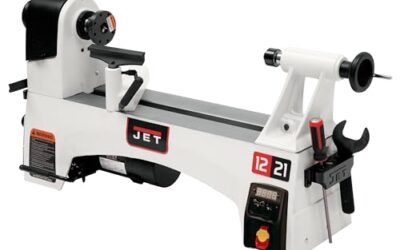
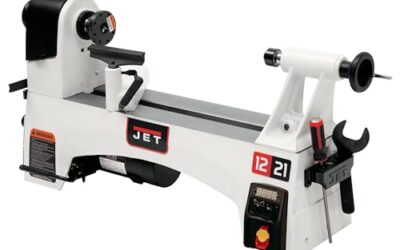
JET JWL-1221VS Variable-Speed Wood Lathe

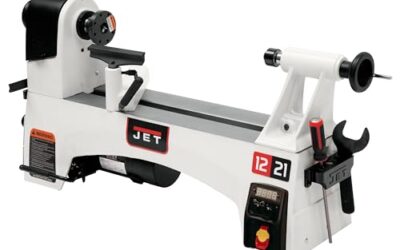
The JET JWL-1221VS is a midi lathe built around a one-horsepower, 115-volt motor and a wide electronic variable speed range. Its listing gives three speed ranges of 60 to 900, 110 to 1,800, and 220 to 3,600 revolutions per minute, which together cover very slow roughing through to fast finishing without leaving large gaps. The controls include a larger digital readout and a recessed power switch, and forward to reverse is described as a smooth transition, which is useful for sanding.
Capacity is twelve and a half inches of swing over the bed in the comparison data on its listing, with about twenty-one inches between centers in the model name and description. The spindle uses a one-inch by eight threads per inch thread with an MT2 taper, matching the common accessory standard for this class. An integrated, spring-loaded spindle lock and an indexing system support layout and drilling tasks that require the spindle to stay in a set position. A ratchet-style belt tension system is intended to make belt range changes quicker than a conventional tension arrangement.
WEN 34035 6-Amp 14-Inch by 20-Inch Variable Speed Benchtop Wood Lathe
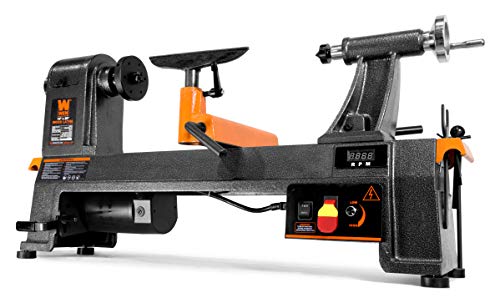
The WEN 34035 offers the largest capacity in this guide: workpieces up to fourteen inches wide and twenty inches long, according to its listing. Variable speed runs from 250 to 3,550 revolutions per minute, adjusted through its variable speed operation rather than a small set of fixed steps. That low end is not as slow as the JET model above, but it is low enough for many prepared bowl blanks, and the top end covers small spindle work and finishing.
The motor is rated at six amps, and the listing describes a sturdy build of more than 120 pounds to prevent walking and wobbling during operation. Included items listed by the manufacturer include an eight-inch tool rest, a headstock spur center, a tailstock live center, an onboard accessory holder, a flat wrench, a knockout rod, hex wrenches, and a four-inch faceplate for turning bowls, cups, and other workpieces. The listing also notes MT2 tailstock and headstock tapers and a one-inch by eight threads per inch spindle thread, which keeps it compatible with common chucks and centers.
Grizzly Industrial T25920 12-Inch by 18-Inch Variable-Speed Benchtop Wood Lathe

The Grizzly T25920 is a twelve-inch by eighteen-inch benchtop lathe with electronic variable speed and a digital spindle speed indicator. Its listing data gives a variable speed range of 300 to 3,700 revolutions per minute, a twelve-inch swing, and eighteen inches between centers. A separate specification summary for the same model lists a three-quarter horsepower, 110-volt, single-phase motor rated at 5.3 amps, a tool rest width just under six inches, a spindle thread of one inch by eight threads per inch, and MT2 tapers for both spindle and tailstock.
That combination places the T25920 squarely in the general-purpose midi category. Twelve inches of swing covers most bowls and vessels a hobby shop produces, eighteen inches between centers covers most spindles and handles, and a digital readout makes speed settings repeatable from one session to the next. The machine weight is listed around seventy-nine to eighty pounds, which is substantial enough for stability while still being more manageable on a bench than the heaviest models in this guide.
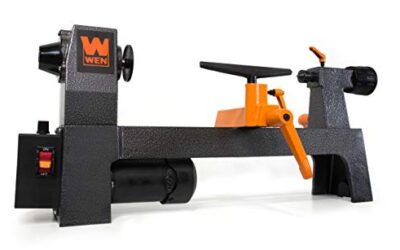
WEN LA3421 Mini Benchtop Wood Lathe, 8-Inch by 13-Inch with Variable Speed

The WEN LA3421 is the compact option in this guide, a mini benchtop lathe with an eight-inch swing and thirteen inches between centers. Its listing identifies it as a 3.2-amp variable speed mini lathe, and summaries of the model give a variable speed range of 750 to 3,200 revolutions per minute. That range is aimed at small work: pens, bottle stoppers, chess pieces, small bowls, cups, and similar projects where the diameter is modest and higher speeds are appropriate.
A mini lathe’s advantage is not raw capacity but fit and focus. It takes less bench space, is easier to store when the bench is needed for other work, and concentrates on the small projects many turners make most often. The trade-offs follow from the size. An eight-inch swing cannot accept a twelve-inch bowl blank, thirteen inches between centers limits long spindles, and the higher minimum speed makes very large or unbalanced blanks a poor match. None of that matters if your work is genuinely small, and it matters a great deal if it is not, so be honest about your project list before choosing the smallest machine.
Which Benchtop Variable Speed Lathe Should You Pick?
Start with diameter, then length, then speed control. If you turn mostly pens, stoppers, and small bowls on a crowded bench, the WEN LA3421 matches that work and leaves bench space for everything else. Its limits are clear and, for that project list, not relevant.
If you want one general-purpose midi lathe for bowls, vessels, and spindles, compare the Grizzly T25920 and the JET JWL-1221VS. Both offer twelve-inch class swing and electronic variable speed with a readout. The Grizzly is the lighter machine with eighteen inches between centers and a low end around three hundred revolutions per minute in its listing data. The JET offers a one-horsepower motor, a much lower starting speed in its lowest range, forward and reverse operation, and more length between centers, at the cost of considerably more weight. Turners who rough out large, unbalanced bowl blanks will value that very low JET range. Turners who work mainly with prepared blanks and want a more movable bench machine may prefer the Grizzly balance.
If diameter is your recurring frustration, the WEN 34035 is the capacity pick. Fourteen inches of swing and twenty inches between centers give it room the other models do not have, and its variable speed range covers roughing through finishing for that larger work. Choose it when you can name the projects that need the extra swing, not simply because bigger sounds better, because you will handle its size and weight every time you use the bench.
Whichever model you choose, budget attention for the accessories that make a lathe usable for your work: a chuck matched to the spindle thread, a live center and drive center matched to the tapers, a tool rest size suited to your projects, and turning tools and sharpening for them. A lathe without a way to hold your intended work securely is not yet a complete setup.
Safety and Setup Notes
Set the lathe on a rigid, level bench and secure it according to the manufacturer’s instructions before turning anything. Check that the headstock and tailstock centers align, that the tool rest locks firmly and sits close to the work without touching it, and that the banjo moves and locks smoothly along the bed. Spin every newly mounted blank by hand first to confirm clearance over the bed and tool rest.
Start every new blank at a low speed and increase only after the piece is balanced and round. Stand to the side, out of the line of rotation, when you first switch on after mounting or remounting work. Wear eye protection and a face shield for bowl work, avoid loose clothing, sleeves, jewelry, and gloves near rotating work, and keep long hair tied back. Let the lathe stop fully before adjusting the tool rest, changing a belt range, or measuring the work.
Frequently Asked Questions
What is the difference between a mini and a midi benchtop wood lathe?
Mini lathes are the smallest benchtop models, typically around eight to ten inches of swing and shorter beds, suited to pens and small bowls. Midi lathes are larger benchtop models, commonly around twelve to fourteen inches of swing and longer beds, suited to larger bowls and spindles while still sitting on a bench rather than on their own floor stand.
Do I need electronic variable speed, or are belt speeds enough?
Belt speeds are enough if you turn similar work and change speed infrequently. Electronic variable speed is worth choosing if you rough and finish pieces of very different diameters in the same session, because you will actually use the appropriate speed instead of settling for the nearest step. A digital readout adds repeatability when you want to return to a known setting.
What speed should I use for a bowl blank?
Start low, especially while the blank is out of round, and increase speed as it becomes balanced and true. Larger diameters need lower speeds than smaller diameters. Use the lathe manufacturer’s guidance and your model’s range, and reduce speed immediately if vibration increases, rather than trying to push through it.
Can a benchtop lathe turn table legs?
Yes, within its distance between centers. A leg turned in one piece needs a bed at least as long as the leg section being turned, plus room for centers and any chuck. Longer legs may be turned in sections, made on a lathe with a bed extension where one is offered for that model, or handled on a larger machine. Check the between-centers figure against your actual leg design before buying.
What spindle thread and taper should I look for?
For this class of lathe, a one-inch by eight threads per inch spindle and MT2 headstock and tailstock tapers are a practical combination because so many chucks, faceplates, drive centers, live centers, and drill chucks are made to fit them. Whatever a model uses, confirm the thread and tapers in its listing before ordering accessories, because accessories with the wrong thread or taper will not fit directly.
How heavy should a benchtop lathe be?
Heavier cast iron machines generally run with less vibration, especially on unbalanced blanks, but they are harder to move and need a stronger bench. Lighter machines are easier to reposition and store. Match the weight to how you will use it: a permanent turning station can accept a heavy midi lathe, while a shared bench may call for a lighter mini or midi model you can move with care.
Related guides
More from Amazon
Programs that pair well with the guide above. Offers and eligibility are set by Amazon and may change.
Free shipping on eligible items, Prime Video and more. Eligible new members can start with a free trial.
Start a Prime free trialAudiobooks and podcasts to listen to on the go. Eligible new members can start with a free trial.
Try Audible freeAd-free music streaming. Eligible new subscribers can start with a free trial.
Try Music Unlimited freeA free business account with business pricing and bulk-buying tools for work, shop or home office.
Create a business accountAs an Amazon Associate we earn from qualifying purchases.
Write Your Review
No reviews yet. Be the first to share your experience!