
Key takeaways
- Compare midi wood lathes with variable speed controls for bowls and spindles, covering swing, motor power, speed ranges and spindle size in detail.
What's inside
As an Amazon Associate I earn from qualifying purchases. This post may contain affiliate links at no extra cost to you.
Choosing a midi lathe is really a decision about speed control and capacity, not just about size. A rough, out-of-balance bowl blank needs a slow, steady start, while a small spindle or pen blank needs high speed for a clean finish, and stopping to move a belt for every change quickly becomes the part of turning you dread. If the low end is not slow enough, or the motor stalls under a heavier cut, the machine limits your projects from the first day.
This guide is for bench-top turners who work on bowls, spindles, cups and furniture parts in a small shop or garage and want electronic variable speed rather than fixed pulley steps. The picks were chosen from their Amazon titles and listed specifications, comparing swing over the bed, distance between centers, motor output, speed ranges, spindle thread and included rests and centers, so each recommendation below is tied to a stated figure rather than a vague claim.
Quick Picks
As an Amazon Associate we earn from qualifying purchases
| Product | Best for | Key spec from title |
|---|---|---|
| JET JWL-1221VS 12 x 21 Variable-Speed Woodworking Lathe | Slow roughing and longer spindles | 1 HP, 115V, variable speed |
| WEN 34035 6-Amp 14-Inch by 20-Inch Variable Speed Benchtop Wood Lathe | Largest capacity in this group | 6-Amp motor, 14-inch by 20-inch capacity |
| Delta Industrial 46-460 12-1/2-Inch Variable-Speed Midi Lathe | High top speed and reversing | 12-1/2-inch swing, variable speed |
How to Choose
Swing and distance between centers
Swing over the bed sets the largest diameter you can turn, and distance between centers sets the longest spindle you can fit. A 12-inch or 12-1/2-inch swing handles most serving bowls, platters and small hollow forms, while a 14-inch swing gives useful headroom for a wider blank that is not perfectly round at the start. For example, a turner making 11-inch salad bowls needs that clearance plus room for the tool rest base, whereas a turner making chair spindles should prioritise 20 or 21 inches between centers over extra swing. Measure your typical blank, then buy for that size with a little margin, not for a rare oversized idea.
How the variable speed system works
Not all variable speed controls work the same way. Some midi lathes use electronic control within two or three belt ranges, so you still move the belt occasionally but adjust speed with a dial inside each range, while others cover most work from the dial alone. The low end matters most for roughing: a range starting near 60 RPM lets you start an uneven blank cautiously, while a low end near 250 RPM is still workable for balanced stock. Check the stated ranges carefully, for instance 250 to 720, 600 to 1700 and 1200 to 3550 RPM, and consider how often your projects would force a belt change.
Motor power and low-speed torque
Motor figures are listed differently across brands, with some models stated in horsepower and others in amps, so compare them alongside the speed ranges rather than in isolation. A 1 HP midi lathe should hold speed better on a dense 10-inch bowl blank than a smaller motor, especially at low RPM where torque matters more than top speed. A 6-amp motor on a larger 14-inch machine is aimed at the same kind of work, driving bigger blanks and longer spindles. If you plan to core bowls, turn green wood or take heavier roughing cuts, favour the stronger motor and the lower starting speed; for pens and light spindles, outright power is less decisive.
Spindle thread, tapers and included accessories
Accessories only fit if the spindle thread and tapers match, so confirm those figures before you buy. The common pattern in this group is a 1-inch by 8 TPI spindle thread with MT2 headstock and tailstock tapers, which matches a wide range of chucks, drive centers and live centers. Also check what is in the box: a faceplate for bowl work, spur and live centers for spindle work, and the length of the tool rest all change what you can start on day one. For example, an 8-inch tool rest suits longer spindles, while a shorter rest is easier to position close to a small bowl, so having the right rest included saves an immediate extra purchase.
The 3 Best Options
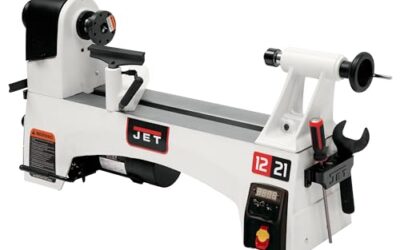
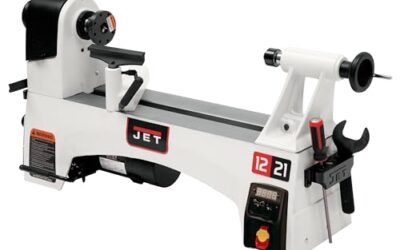
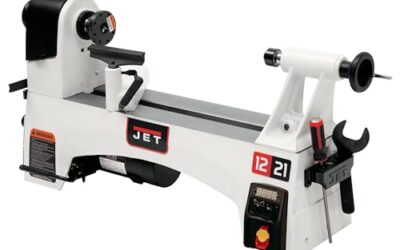
JET JWL-1221VS 12 x 21 Variable-Speed Woodworking Lathe

The JET JWL-1221VS suits turners who want the widest usable speed range in a midi format, especially for roughing bowls slowly and then finishing smaller work at high speed. Its listed range starts far lower than the other picks here, which helps when a blank is uneven or heavy on one side. With 21 inches between centers in its title size, it also covers longer spindles, lamp bases and furniture parts without needing an extension straight away. Turners who mix bowls and spindles in roughly equal measure, and who value a slow, controlled start, will get the most from this combination of capacity and control.
Specs
- Model: JWL-1221VS
- Size from title: 12 inch by 21 inch
- Motor: 1 HP, 115V, 1Ph
- Speed: Variable speed, 60 to 3600 RPM in belt ranges
- Swing over bed: 12-1/2 inches
- Spindle thread: 1 inch by 8 TPI
- Spindle and tailstock taper: MT2
- Indexing: 24 positions
Best for: Turners who rough out uneven bowl blanks and also turn longer spindles.
Watch out for: The stand and bed extension are separate purchases, so allow bench space for the lathe itself.
WEN 34035 6-Amp 14-Inch by 20-Inch Variable Speed Benchtop Wood Lathe
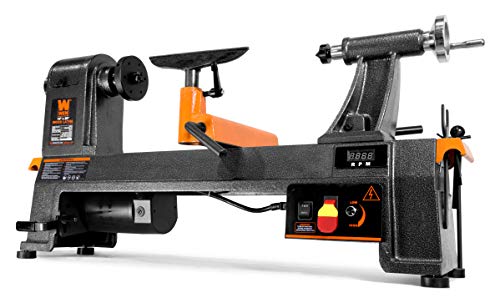
The WEN 34035 is the capacity pick in this guide, with a 14-inch swing and 20 inches between centers from its title, giving more room than the 12-inch machines for wider bowls, cups and longer workpieces. Its variable speed is adjustable anywhere from 250 to 3550 rotations per minute, covering roughing, shaping and finishing without returning to fixed pulley speeds. The listing highlights MT2 tapers, a 1-inch by 8 spindle thread and an onboard accessory holder, which will appeal to turners who want compatibility with common accessories and a tidy bench. It fits a growing hobby shop that has started to outgrow a smaller mini lathe.
Specs
- Model: 34035
- Motor: 6-Amp, 120V, 60 Hz
- Capacity from title: 14-inch by 20-inch
- Swing over bed: 14 inches
- Distance between centers: 20 inches
- Speed: Variable speed, 250 to 3550 RPM, in ranges of 250 to 720, 600 to 1700 and 1200 to 3550 RPM
- Spindle taper: MT2
- Tailstock taper: MT2
- Spindle thread: 1 inch by 8 TPI
- Tool rest: 8 inches
- Faceplate: 4 inches
- Included centers: MT2 spur center and MT2 live center
Best for: Turners who want the largest bowl and spindle capacity on a bench-top midi lathe.
Watch out for: Its low speed starts at 250 RPM, so very uneven large blanks need extra care at start-up compared with a lower starting range.
Delta Industrial 46-460 12-1/2-Inch Variable-Speed Midi Lathe

The Delta Industrial 46-460 is aimed at turners who want a 12-1/2-inch midi lathe with a high top speed and forward and reverse operation for finishing work. Its 16-1/2 inches between centers suits bowls, boxes, tool handles and shorter spindles, and the variable speed range reported for this model reaches up to 4000 RPM, which is useful for small-diameter work that benefits from higher speed. The listing describes a ball-bearing live center, a heavy-duty steel knockout bar and onboard storage for adjustment tools. It is a good fit for a dedicated turning bench where most projects are bowls and medium spindles rather than long furniture legs.
Specs
- Model: 46-460
- Size from title: 12-1/2-inch swing
- Motor: 1 HP
- Swing over bed: 12-1/2 inches
- Distance between centers: 16-1/2 inches
- Speed: Variable speed, 250 to 4000 RPM in three ranges
- Spindle thread: 1 inch by 8 TPI
- Included: Ball-bearing live center and steel knockout bar
- Tool rests listed for this model: 6-inch and 10-inch
Best for: Bowl and box turners who want reversing and a high top speed in a midi format.
Watch out for: At 16-1/2 inches between centers it is the shortest bed here, so long spindle work would need the extension option for this model.
Which One Fits Your Situation
You mostly turn bowls from rough blanks
Choose the JET JWL-1221VS if your blanks are often green, uneven or close to the full swing of the machine. Its very low starting speed lets you bring a heavy blank up to speed gradually, and the 1 HP motor supports steady roughing cuts. The WEN is the alternative when the bowl diameter itself is the priority, because its 14-inch swing accepts a wider blank from the outset, provided the blank is reasonably balanced before you start.
You want one lathe for bowls and furniture spindles
Pick the WEN 34035 for the broadest mix in a single bench-top machine. The 20 inches between centers covers many table legs, rolling pins and long handles, while the 14-inch swing still leaves room for a substantial bowl. Its speed range from 250 to 3550 RPM spans both jobs without fixed steps. If your spindle work regularly runs longer than that, the JET, with 21 inches between centers in its title size, gives a small but useful extra margin.
You turn small work and care about finishing
Consider the Delta Industrial 46-460 when your projects lean toward boxes, small bowls, finials and other pieces where higher speed and reverse operation help with finishing cuts and sanding direction. Its shorter bed matters less for this kind of work, and the included live center and knockout bar cover the basics for spindle and faceplate turning. Keep the tool rest close, run small diameters at the higher end of the range, and let the variable control do the adjustment work instead of changing setups between pieces.
Your bench space and lifting limit are tight
All three machines are bench-top midi lathes and are heavy for their size, so plan the bench first and treat any of them as a two-person lift. The Delta, with the shortest distance between centers, presents the most compact footprint of this group for a small dedicated turning corner. The JET and WEN need more bench length for their longer beds. Whichever you choose, leave clear space at the tailstock end for removing the knockout bar and at the headstock end for chuck changes.
Common Mistakes
- Buying on swing alone and ignoring distance between centers, then finding that a planned spindle or leg project does not fit between the headstock and tailstock.
- Starting an out-of-balance blank too fast instead of using the lowest variable speed range first and increasing speed only once the blank runs true.
- Assuming every chuck fits, without checking that the spindle thread is 1 inch by 8 TPI and that the tapers are MT2 on the lathe you are buying.
- Mounting a heavy midi lathe on a light or flexible bench, which adds vibration that no speed setting can correct.
- Forgetting the accessories a project needs, such as a faceplate for bowls or a live center for spindles, and discovering they are not included with the machine.
Frequently Asked Questions
What makes a lathe a midi lathe rather than a mini or full-size model?
A midi lathe sits between the two, typically with a swing around 12 to 16 inches and a bench-top bed, as with the 12-inch, 12-1/2-inch and 14-inch models in this guide. It offers enough capacity for real bowls and spindles while still fitting in a small shop, whereas mini lathes are smaller and floor-standing models add length, weight and swing that most home turners do not need.
Why does variable speed matter more than fixed pulley speeds?
Variable speed lets you change RPM with a dial or control as the work changes, instead of stopping to move a belt between fixed steps. That matters when you rough a blank slowly, speed up for shaping, and speed up again for a fine finish on the same piece. It also makes it easier to find a speed where vibration settles down, which improves both safety and surface quality.
What speed should I use for a bowl compared with a spindle?
Use the low end of the range for a large or uneven bowl blank and increase speed as the blank becomes round and balanced, because diameter and imbalance drive vibration. Smaller spindles, pens and finials run at much higher speeds for a clean cut, which is why the Delta range reaching 4000 RPM and the JET range reaching 3600 RPM are useful. Always start slow on a new mounting and adjust upward deliberately.
Can I extend a midi lathe later for longer work?
Some midi lathes offer a bed extension as a separate accessory, which increases distance between centers for longer spindles without replacing the whole machine. The JET and Delta models in this guide are both associated with extension options for their respective lines. Check that the extension matches your exact model number before ordering, and remember that a longer bed also needs a longer, stable bench to support it properly.
Related guides
More from Amazon
Programs that pair well with the guide above. Offers and eligibility are set by Amazon and may change.
Free shipping on eligible items, Prime Video and more. Eligible new members can start with a free trial.
Start a Prime free trialAudiobooks and podcasts to listen to on the go. Eligible new members can start with a free trial.
Try Audible freeAd-free music streaming. Eligible new subscribers can start with a free trial.
Try Music Unlimited freeA free business account with business pricing and bulk-buying tools for work, shop or home office.
Create a business accountAs an Amazon Associate we earn from qualifying purchases.
Write Your Review
No reviews yet. Be the first to share your experience!