
Key takeaways
- Best midi wood lathes with digital speed displays: two verified 12-inch benchtop picks with published RPM readouts, compared on swing and speed range.
What's inside
As an Amazon Associate I earn from qualifying purchases. This post may contain affiliate links at no extra cost to you.
A midi wood lathe is the size class most home turners actually live with: big enough for bowls and table legs, small enough to sit on a workbench and leave room for the rest of the shop. A digital speed display sounds like a minor convenience until you have turned without one — then you realise how much of spindle and bowl work depends on knowing your exact RPM rather than guessing from a dial position. This guide covers the best midi wood lathes with digital speed displays that could be verified on Amazon US at the time of writing. To be transparent: both verified picks are 12-inch benchtop lathes — the midi size class — and each listing publishes its digital speed display in its own words. One listing describes a “High Definition Digital Display… can clearly show the RPM” and lists its style as “Digital display”; the other publishes a “larger DRO” (digital readout) in its seller bullets. The picks below were selected from published listing specifications, not from detailed research, and every specification quoted comes from the product’s own Amazon page.
As an Amazon Associate, we earn from qualifying purchases.
Quick answer
For a clearly documented digital readout, the CXRCY 12″×18″ Wood Lathe (B0C8N3P9RJ) is the direct match for this keyword: its page states the display shows the RPM, it is styled as a digital-display model, and it pairs a 3/4 HP motor with a wide 650–3800 RPM variable speed range in a compact 12″×18″ benchtop format. For a larger capacity in the same class, the JET JWL-1221VS (B00BGBVJCU) stretches the format to 12″×21″, publishes a larger digital readout in its seller bullets, and offers variable speed ranges within 60–3,600 RPM — reaching far lower speeds than the CXRCY, which matters for large, out-of-balance bowl blanks. Choose the CXRCY for the clearest published display description and a simpler footprint; choose the JET for slow-speed control and the extra length between centres.
Key takeaways
- Both picks are 12-inch-swing benchtop lathes — the midi class — and both publish a digital RPM readout on their Amazon pages, though they describe it differently.
- Speed range is the real dividing line: the CXRCY runs 650–3800 RPM, while the JET’s ranges sit within 60–3,600 RPM, and that low end is what large bowl blanks need.
- Swing (12 inches on both) caps your bowl diameter; distance between centres (18 inches vs 21 inches) caps your spindle length.
- A digital readout matters most when you change speed often — roughing, sanding, and finishing all want different RPM, and the display lets you return to a known number instead of re-guessing.
The picks
1. CXRCY 12″×18″ Wood Lathe

The CXRCY is the pick whose listing most directly answers this keyword. Its Amazon page publishes a “High Definition Digital Display” that “can clearly show the RPM,” and the listing’s style field is given as “Digital display” — so the readout is not an inference from a photo or a reviewer comment; it is how the seller describes the machine. In a 12″×18″ benchtop format, that makes it a midi lathe built around exactly the feature this guide is about: knowing your spindle speed at a glance while you work.
Under the display sits a 3/4 HP motor with variable speed from 650 to 3800 RPM. That range covers the working heart of midi turning — spindle work such as pens, tool handles, and chair parts at the upper end, and modest bowls and platters in the middle. The honest limit to note is the floor: 650 RPM is a sensible minimum for small, well-balanced work, but it is not a slow speed for a large, rough, out-of-balance blank. If your turning leans toward smaller, balanced pieces and you want the display front and centre, this is the straightforward choice.
Specs
- Swing: 12 inches
- Distance between centres: 18 inches
- Motor: 3/4 HP
- Speed range: 650–3800 RPM, variable
- Display: High Definition Digital Display showing RPM (as published); style listed as “Digital display”
- Format: benchtop
View it on Amazon: https://www.amazon.com/dp/B0C8N3P9RJ
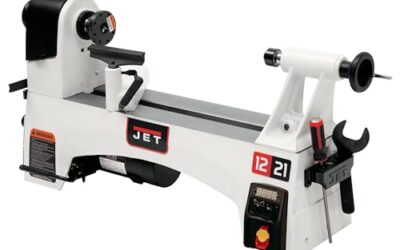
2. JET JWL-1221VS

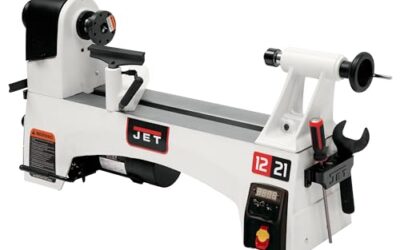
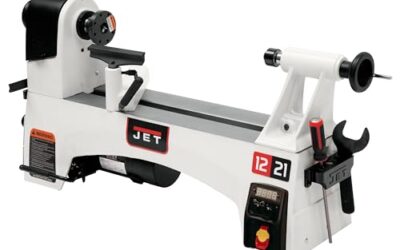
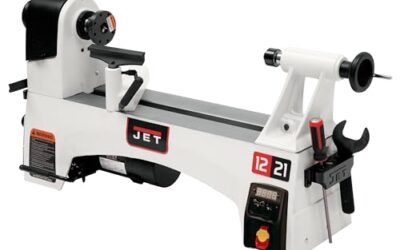
The JET JWL-1221VS is the bigger, slower-turning option in this midi pairing. Its format is 12″×21″ — the same 12-inch swing, but three extra inches between centres, which is the difference between turning a short spindle and turning a full table leg or a longer rolling pin without extensions. Its seller bullets publish a “larger DRO” — a digital readout — so the speed display is part of the machine’s listed equipment, presented as an enlarged readout rather than a small afterthought window.
Where the JET separates itself is the bottom of its speed range. Its variable speed ranges fall within 60–3,600 RPM, and that 60 RPM floor is a genuinely different capability: it lets you start a large, uneven bowl blank slowly and safely, walking the speed up as the piece comes into balance, instead of committing to a fixed minimum of several hundred RPM. The trade-off is at the top — 3,600 RPM is slightly below the CXRCY’s ceiling — but for most midi turning the low end is worth more than the last two hundred RPM at the top. If bowls and longer spindles are your direction, this is the pick.
Specs
- Swing: 12 inches
- Distance between centres: 21 inches
- Speed: variable speed ranges within 60–3,600 RPM
- Display: larger DRO (digital readout), as published in the seller bullets
- Format: benchtop
View it on Amazon: https://www.amazon.com/dp/B00BGBVJCU
How to choose
Start with the two capacity numbers, because they decide what you can physically mount. Swing over the bed — 12 inches on both lathes here — is the largest diameter blank that can rotate without striking the bed, and in practice your comfortable bowl diameter is a little under that figure. Distance between centres — 18 inches on the CXRCY, 21 inches on the JET — is the longest spindle you can hold between the headstock and tailstock. Pens, bottle stoppers, and small handles fit either machine; a set of table legs or a long rolling pin pushes you toward the 21-inch machine, or toward a bed extension on the shorter one.
Next, read the speed range from the bottom up, not the top down. High RPM is easy to advertise, but the minimum speed is what determines whether you can safely rough out a large, out-of-balance bowl blank. A floor around 60 RPM, like the JET’s published range, lets you creep up on balance; a floor of 650 RPM, like the CXRCY’s, is fine for balanced stock, smaller bowls, and spindle work, but it asks more care with rough blanks. At the other end, spindle work — pens, finials, thin spindles — rewards higher speeds for cleaner cuts, and both machines reach well into the range that work needs.
Then think about why the digital display is on your list at all, because it should change how you work, not just decorate the headstock. A published RPM number lets you work repeatably: note the speed that gave you a clean cut on a given wood, and you can return to it exactly on the next piece. It helps when you step through a process — roughing speed, then a slower sanding speed, then a finishing speed — and it is a genuine safety aid, because the safe speed for a blank depends on its diameter, and a readout lets you set a diameter-appropriate speed deliberately instead of estimating from a knob position. When you compare listings, prefer machines whose pages state the readout plainly, as both of these do, in their own words.
Finally, weigh motor and format honestly. The CXRCY publishes a 3/4 HP motor, which is squarely in midi territory and adequate for the swing it carries; the JET’s listing, as captured for this guide, does not rest on a horsepower figure, so judge it on its published capacity and speed ranges rather than an assumed number. Both machines are benchtop format, so plan for a sturdy bench or stand: a midi lathe is light enough to move, but vibration control comes from mass and mounting, and a rigid surface matters more as blanks get bigger. Whichever you choose, leave bench depth for the tailstock end and room to stand clear of the line of rotation.
Who should skip
Skip both of these lathes if your work is genuinely full-size. If you plan to turn bowls well beyond 12 inches, long bed posts, or architectural spindles, a midi benchtop machine is the wrong class entirely — you need a full-size floor lathe with a larger swing, and no display feature compensates for a blank that physically does not fit. Equally, if you turn only small, balanced spindle work and never change speed mid-project, the digital readout is a feature you will rarely use; a simpler variable-speed mini or midi lathe serves that work without paying for the display. And if your priority is the slowest possible roughing speed for very large, rough blanks, note that only one of these two picks reaches down to double-digit RPM — choose accordingly rather than expecting both to behave the same.
FAQ
What makes a lathe a “midi” lathe?
Midi is the middle size class of wood lathes: larger than a mini lathe, smaller than a full-size floor lathe. In practice it means a benchtop machine with roughly a 12-inch swing and around 18 to 21 inches between centres — exactly the published formats of both picks here. It is the class aimed at bowls, platters, and furniture spindles in a home workshop.
Why does a digital speed display matter on a wood lathe?
Because safe and effective turning speed depends on the diameter and balance of the blank. A digital readout shows the actual RPM, so you can set a slower speed for a large or rough blank, speed up for small spindle work, and return to a known speed for sanding or for repeating a cut that worked. Without it, you are estimating from a dial or knob position, and the same position can mean different things as belts and ranges change.
What speed should I use for bowls versus spindles?
As a working pattern: larger, rougher pieces start slower, and smaller, balanced pieces run faster. A big bowl blank may begin in the low hundreds of RPM — or lower, on a machine like the JET whose published range starts at 60 RPM — and climb as it comes round. Spindle work such as pens and handles typically runs in the upper part of the range. Both picks publish variable speed, so the technique is the same: start low, increase only when the piece runs true, and let the display confirm where you are.
Can these lathes handle a table leg?
A table leg is a between-centres spindle, so the deciding figure is distance between centres: 18 inches on the CXRCY and 21 inches on the JET. Shorter legs and leg sections fit either machine; a longer leg needs the 21-inch capacity or a bed extension. Check the leg length you actually plan to turn against the published figure before choosing, because swing — the number buyers usually compare — is not the limit for this job.
Final verdict
Both of these midi lathes publish a digital speed readout on their Amazon pages, but they suit different turners. The CXRCY 12″×18″ is the most literal match for the keyword: its page states plainly that its High Definition Digital Display shows the RPM, its style is listed as “Digital display,” and its 3/4 HP motor and 650–3800 RPM range fit balanced spindle work and modest bowls in the smallest footprint. The JET JWL-1221VS is the choice when the work gets bigger and rougher — 21 inches between centres for longer spindles, a published larger DRO, and speed ranges reaching down to 60 RPM for safe starts on out-of-balance blanks. Decide by your blanks: if they are small and balanced, take the CXRCY; if they are long or rough, take the JET.
Product and ASIN Reference
| Product | ASIN |
|---|---|
| CXRCY 12″×18″ Wood Lathe | B0C8N3P9RJ |
| JET JWL-1221VS | B00BGBVJCU |
Related guides
More from Amazon
Programs that pair well with the guide above. Offers and eligibility are set by Amazon and may change.
Free shipping on eligible items, Prime Video and more. Eligible new members can start with a free trial.
Start a Prime free trialAudiobooks and podcasts to listen to on the go. Eligible new members can start with a free trial.
Try Audible freeAd-free music streaming. Eligible new subscribers can start with a free trial.
Try Music Unlimited freeA free business account with business pricing and bulk-buying tools for work, shop or home office.
Create a business accountAs an Amazon Associate we earn from qualifying purchases.
Write Your Review
No reviews yet. Be the first to share your experience!