Best Midi Wood Lathes for Garage Workshops: Top Picks
Compare five midi wood lathes for a garage workshop by swing, distance between centers, motor power and speed control, with full published specs for each.
Compare five midi wood lathes for a garage workshop by swing, distance between centers, motor power and speed control, with full published specs for each.
As an Amazon Associate I earn from qualifying purchases. This post may contain affiliate links at no extra cost to you.
A garage workshop asks a lot of a wood lathe. The machine has to share floor and bench space with vehicles, storage boxes, garden tools and everything else a household garage holds, yet it still needs the capacity and power to turn bowls, spindles, tool handles, table legs and gift projects without feeling like a toy. That is exactly the gap the midi lathe fills. Midi lathes sit between the small mini lathes built mainly for pens and tiny work and the full-size floor-standing machines that demand a dedicated corner of a large shop. Most midi models cluster around a 12-inch to 12-1/2-inch swing over the bed, carry motors from 3/4 HP to 1 HP, and sit on a bench rather than a stand, so they suit a garage bench run along one wall.
This guide compares five midi wood lathes that fit that garage brief: the JET JWL-1221VS, the Delta 46-460, the Laguna Revo 12|16, the RIKON 70-220VSR and the NOVA Comet II. Every figure in the spec blocks comes from the manufacturer or the product listing for that model, so you can compare swing, distance between centers, motor output and speed control on equal terms.
Disclosure: As an Amazon Associate, we earn from qualifying purchases made through links on this page, at no extra cost to you.
What Makes a Lathe a Midi, and Why It Suits a Garage
Manufacturers draw the midi line by capacity and footprint rather than by a single strict definition. A midi lathe generally offers around 12 inches of swing over the bed, which means it can turn a bowl blank up to roughly 12 inches in diameter, and between 15 and 21 inches of length between centers in standard trim. Motors are usually 3/4 HP or 1 HP, enough for bowls in the 8 to 10 inch range and for spindle work such as chair legs, rolling pins and baseball bats in sections. The bed is cast iron on most models in this class, which adds the mass that keeps a benchtop machine steady when a rough, out-of-balance blank starts spinning.
For a garage, the benchtop format matters as much as the numbers. A midi lathe can live on a sturdy bench and leave the floor clear for a car, or it can be bolted to a shop-made stand with casters and rolled aside when the space is needed for something else. Most run on an ordinary household circuit, so no special wiring is required. Electronic variable speed, fitted to all five machines in this guide, is the other garage-friendly feature: speed changes happen from a dial or control box instead of by moving a belt for every adjustment, although most of these lathes still use two or three belt positions to reach their full speed span.
The Five Midi Lathes Compared
1. JET JWL-1221VS
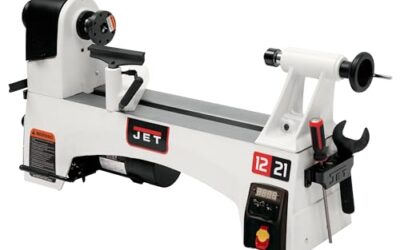
The JET JWL-1221VS is the reference point for this class and the machine many turners measure the rest against. Its cast iron bed gives it real heft for a benchtop unit, and the 1 HP motor pairs with electronic variable speed that runs from a very slow 60 RPM up to 3,600 RPM across three belt ranges. That slow bottom end is genuinely useful in a garage setting, where a large, uneven bowl blank needs to be trued up gently before the speed climbs. JET builds in a 24-position indexing head, a spindle lock and forward and reverse running, and the 21-3/8 inches between centers is the longest standard capacity in this group, so longer spindles fit without an extension. The controls are straightforward, the speed readout is clear, and the machine carries the fit and finish expected at this end of the midi range.
Specs
Swing over bed: 12-1/2 in
Distance between centers: 21-3/8 in
Motor: 1 HP, 115V, single phase
Speed control: Electronic variable speed, 60 to 3,600 RPM across three ranges (60–900, 110–1,800 and 220–3,600 RPM)
The Delta 46-460 has been a garage and small-shop staple for years, and its layout explains why. The 1 HP motor drives the spindle through three belt ranges with electronic variable speed inside each range, giving a span from 250 RPM to 4,000 RPM, the highest top speed in this group and a good match for small-diameter spindle work and pens as well as bowls. A forward and reverse switch helps with sanding and finishing. The standard 16-1/2 inches between centers covers most furniture parts, and Delta offers a bed extension that stretches capacity to 42 inches for the occasional long project, which is a practical path for a garage turner who only sometimes needs the extra length. Onboard storage for the adjustment tools and a ball-bearing live center are included in the listing specification.
Laguna positions the Revo 12|16 as the definitive midi lathe, and its drive system is the reason it stands apart here. Instead of a conventional motor, it uses a 1 HP DC permanent magnet motor governed by a pulse width modulation controller, a setup Laguna specifies to hold torque at very low speeds. The lowest range starts at 50 RPM, which suits large or unbalanced blanks that need a cautious first pass. The castings are wide and heavy for the class, the control panel is an anodised aluminium plate with a digital readout, and the belt change uses a cam-action, one-step system behind a magnetic door. Between centers is 15.5 inches in standard trim, the shortest in this group, but an optional extension takes it to 25 inches and enables outboard turning up to a 16-inch swing for bigger bowls.
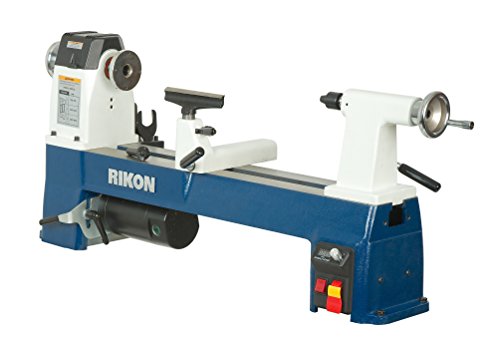
The RIKON 70-220VSR is the capacity pick of this group. It matches the 12-1/2-inch swing of the JET, Delta and Laguna while offering 20 inches between centers as standard, so it handles longer spindles without any extension fitted. The 1 HP motor is paired with electronic variable speed from 250 to 3,850 RPM across three pulley ranges, and RIKON mounts the controls in a separate box that can be positioned where it suits the turner, a thoughtful touch when the lathe sits on a crowded garage bench. A digital readout shows the selected speed, the headstock carries a spindle lock and indexing, and the cast iron construction keeps the machine planted. For a garage turner whose project list leans toward table legs, tool handles and longer hollow forms, this is the most straightforward fit of the five.
Teknatool markets the Comet II as a midi lathe with a difference: its Versaturn adaptable system lets the headstock drive a range of attachments, including a grinding wheel, belt sander and sanding disc, which is an appealing idea in a garage where one machine often has to cover several jobs. As a lathe, it offers a 12-inch swing and 16.5 inches between centers, extendable to 42 inches with the optional bed extension. The 3/4 HP motor is the smallest here, but the electronic variable speed runs from 250 to 4,000 RPM through a three-step pulley, matching the Delta at the top end, and forward and reverse running is included. It is also the lightest machine in this group at a little over 80 pounds as listed, which matters if the lathe has to be lifted off the bench and stored between sessions.
Specs
Swing over bed: 12 in
Distance between centers: 16.5 in (up to 42 in with the optional bed extension)
How to Choose the Right Midi Lathe for Your Garage
Start with the work you actually plan to turn. Bowl turners should look first at swing and low-speed behaviour: every machine here turns a blank of about 12 inches, but the JET and the Laguna reach down to 60 and 50 RPM, which makes roughing out an uneven blank calmer work. Spindle turners should look at distance between centers: the JET at 21-3/8 inches and the RIKON at 20 inches take longer stock as standard, while the Delta and NOVA rely on optional extensions to reach their maximum figures.
Motor size divides the group into two tiers. The four 1 HP machines have more in reserve for wider bowls and heavier cuts, while the NOVA’s 3/4 HP motor suits smaller work and rewards a lighter touch. Speed control style is the third filter. All five offer electronic variable speed, but the Laguna’s pulse width modulation drive is specified for torque at low speed, and the RIKON’s movable control box is worth weighing if your bench layout puts the headstock controls in an awkward spot.
Finally, plan the physical setup. These lathes weigh roughly 80 to 130 pounds, so a solid bench or a purpose-built stand is part of the purchase, and a mobile base helps in a garage that still parks a car. Leave room at the tailstock end for the knockout bar and for sliding the tailstock off, and keep turning tools, a chuck and blanks within reach of the bench rather than across the garage.
Frequently Asked Questions
How much space does a midi lathe need in a garage?
Most midi lathes in this class are around 30 to 40 inches long and under 20 inches tall on the bench, so a bench run of about four feet along a wall covers the machine plus elbow room. Leave extra space at the tailstock end for removing the tailstock and using the knockout bar, and enough depth in front of the bench to stand and move along the work.
Can a midi lathe turn bowls, or is it only for spindles?
A midi lathe turns both. The 12-inch to 12-1/2-inch swing on these machines accepts bowl blanks up to about that diameter, and the low speed ranges on the JET, Laguna and RIKON are there for roughing out blanks that are not yet balanced. Spindle work such as legs, handles and rolling pins uses the distance between centers instead, which runs from 15.5 to 21-3/8 inches across this group.
Do these lathes need a special electrical supply?
No. Each model in this guide is listed for ordinary household power, 110V to 120V single phase, so a standard garage outlet covers it. The Laguna listing recommends a 15 amp breaker. As with any larger garage tool, running the lathe on a circuit that is not already loaded with other heavy equipment is the sensible approach.
Which accessories should a first-time midi lathe owner plan for?
The listings for these machines include the basics such as a tool rest, faceplate, spur drive center and live center. Beyond that, most turners add a four-jaw chuck for bowl work, a set of turning tools, and a way to sharpen them. Because every lathe here uses a 1 inch x 8 TPI spindle thread and #2 Morse tapers, chucks and centers sized to that common standard fit across the whole group.
Closing Thoughts
For a garage workshop, the midi class hits the balance point: real capacity and 1 HP class power in a machine that still lives on a bench. The JET JWL-1221VS is the all-round benchmark, the Delta 46-460 adds the highest top speed and an easy extension path, the Laguna Revo 12|16 brings low-speed torque from its pulse width modulation drive, the RIKON 70-220VSR offers the most standard length in the group, and the NOVA Comet II trades a little motor size for light weight and its adaptable accessory system. Match the swing, length and speed figures above to the projects on your list and any of the five will serve a garage shop well.
A
admin88
We compare specs, warranty terms, long-term owner feedback and street pricing before anything earns a spot. Rankings are never paid.
Affiliate disclosure. As an Amazon Associate we earn from qualifying purchases at no extra cost to you. Prices accurate as of the date shown.
Benchtop wood lathes with reverse rotation compared on swing, distance between centers, speed ranges, motor power and spindle thread, from the listings.
Compare the best benchtop wood lathes with digital speed displays, from compact midi lathes to heavy-duty models that dial in exact RPMs for every turn.
Compare five benchtop lathes for garage workshops on swing, length between centers, motor and speed control, from an 8-inch mini to a 12-1/2-inch midi.
Compare the best benchtop wood lathes for small professional workshops, with cast-iron midi and mini models, variable speed and honest capacity figures.
Compare WiFi pellet grills by cooking area, hopper size and app control, from Traeger and Camp Chef to Pit Boss, and pick the right size for your cooks.
Compare the best closed-frame portable generators with electric start by running watts, noise, fuel options and outlets to choose the right quiet inverter.
Compare five pressurized pond filters with UV clarifiers by flow, size and cleaning, so pond water stays clear without constant scrubbing or cloudy weeks.
Compare the best bead pond filters for backyard fish ponds by pond size, flow rate, and backwash design, with picks for ponds from 2,000 to 8,000 gallons.


Write Your Review
No reviews yet. Be the first to share your experience!